Moving to NYC in 2026: The Complete NYC Transplant Guide
On this page
It's your second weekend in New York City. You've found the ideal apartment, survived the move and finally figured out which way is uptown. The TV is on, the coffee is brewing on the stove, you're scrolling through messages and photos from friends back home. Then it hits you: you don't know anyone here yet. The city is full of people, but you don't have anyone nearby to call, grab a coffee with, or just talk to. And suddenly, the apartment feels a little too quiet.
For many newcomers, the hardest part of moving to NYC isn't the logistics. It is what happens after the boxes are unpacked and the excitement wears off. You start wondering: how do I actually build a life here?
In a city of over eight million people, being surrounded by crowds doesn't necessarily mean feeling connected. You can share a subway car with hundreds of people, live in a packed apartment building, and still go days without having a real conversation with someone in person. In fact, according to the NYC Health Department, more than half of New Yorkers report feeling lonely at least some of the time.
So if you've just moved here and haven't found your people yet, you're not alone. Finding an apartment gets you settled in the city. Finding your people is what makes it feel like home.
This guide will help you figure out more than just where to live, whether you're moving for a career opportunity, a degree, or simply because your next chapter belongs in New York. We'll cover everything from navigating the 2026 rental market and avoiding common scams to setting up utilities, finding your neighborhood favorites, and perhaps most importantly, building a social life in this amazing city.
Welcome to Part 1 of The Complete NYC Transplant Guide.
I. Moving to NYC checklist: what to do before you move
New York's rental market moves fast. Desirable apartments can receive multiple applications within days, and landlords often expect applicants to have their paperwork ready before they even schedule a viewing. A little preparation can make the difference. Here's what to sort out before you start looking.
- Budget beyond the first month's rent. Plan for your first month's rent and a security deposit. Then add moving costs, basic furniture, utility deposits, and a cushion for your first few months.
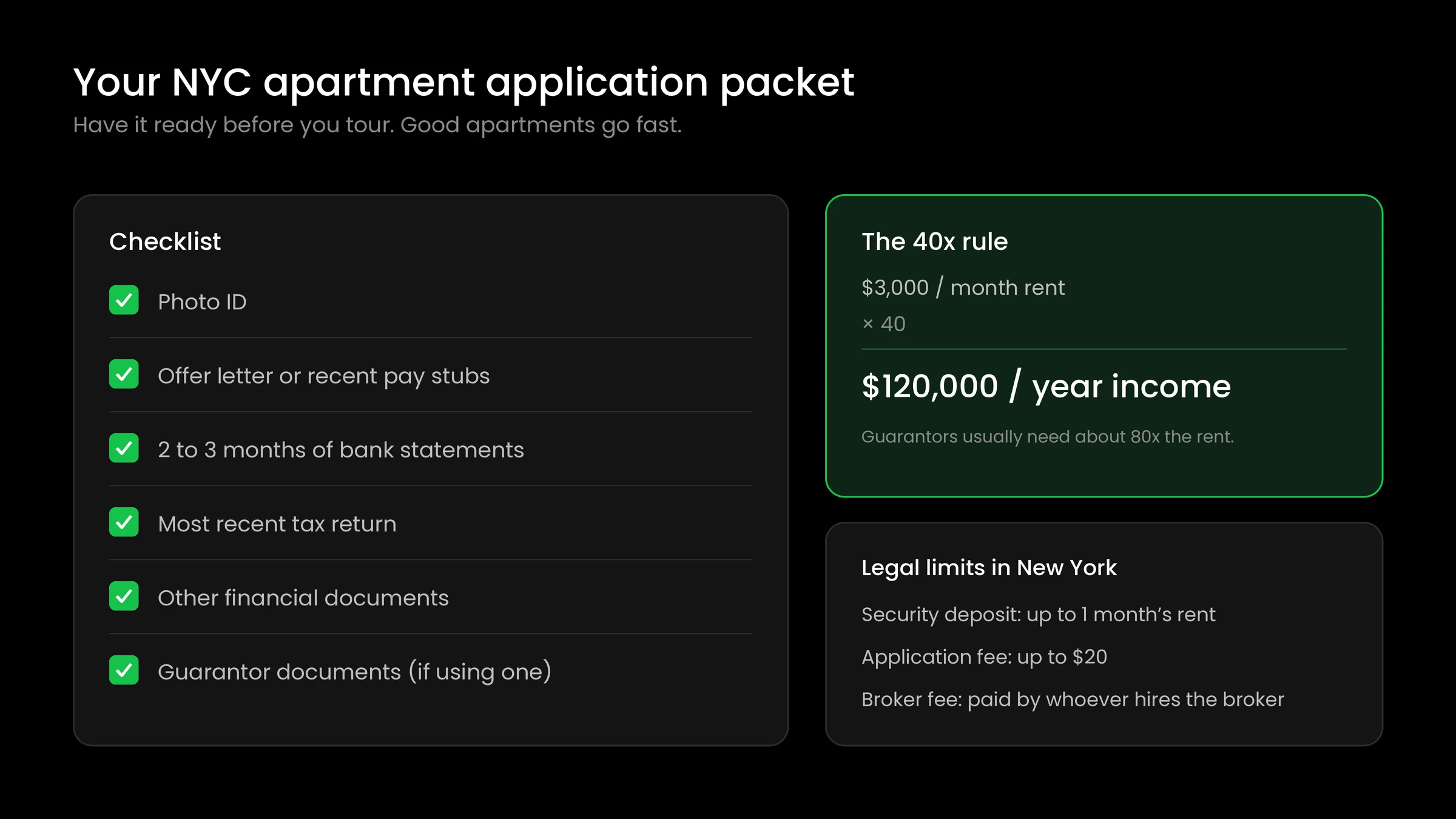
- Understand the 40x rule. Many NYC landlords use an income requirement of approximately 40 times the monthly rent. For a $3,000 apartment, that means an annual income of $120,000. If you don't meet the requirement, you may be able to apply with a roommate and combine incomes, use a guarantor (who may need to earn 80 times the monthly rent), or work with an institutional guarantor service.
- Prepare your application packet. Have digital copies of your photo ID, employment offer letter or recent pay stubs, two to three months of bank statements, most recent tax return, and relevant financial documents. Having everything ready means you can apply the same day you find the right apartment.
- Time your apartment search. Summer is the busiest moving season, with more listings but also more competition. There are fewer options in late fall and winter but you may have more room to negotiate. Most NYC rentals are listed about 30 to 60 days before their availability date. Start actively searching four to six weeks before your move.
- Consider temporary housing first. If you're not sure where you want to live, consider a one- to three-month sublet or furnished rental so you have time to test your commute, explore the neighborhoods and figure out where you actually want to live before committing to a 12-month lease.
II. How to find the right apartment in NYC
Apartment hunting in New York rewards speed, preparation, and knowing your rights. Here are 8 ways to make the process easier.
1. Set alerts for your neighborhoods
Use rental platforms such as StreetEasy, RentHop, Zillow, and Apartments.com to filter listings by price, location, and requirements. Turn on notifications so you can schedule viewings as soon as new apartments appear.
2. Check the building, not just the apartment
Look up the address on HPD Online to review housing violations, complaints and building conditions. A beautiful apartment in a poorly maintained building can quickly become a headache.
3. Visit the neighborhood in person
Walk around during weekday rush hour, late at night, and on weekends. Pay attention to noise, lighting, foot traffic, and how comfortable you feel getting home after dark.
4. Ask the right questions
Who pays for heat and hot water? Is there laundry in the building? How are maintenance requests handled? Is the apartment rent-stabilized? What were the previous rent increases? These details can have a significant impact on your monthly expenses and quality of life.
5. Understand broker fees
NYC's FARE Act, which took effect on June 11, 2025, requires the person who hires the broker to pay the broker's fee. If the landlord hires the broker to list and show an apartment, the landlord cannot pass that fee on to you. You can still choose to hire your own broker and pay for their services.
6. Know your rights as a tenant
New York has some of the strongest tenant protections in the country. Understanding a few key rules can save you thousands of dollars and prevent unpleasant surprises.
Security deposits and application fees. Landlords cannot require a security deposit of more than one month's rent. Credit and background check fees are capped at $20, and landlords must provide the relevant report and receipt when charging the fee.
Good cause eviction. For apartments covered by New York's Good Cause Eviction law, rent increases above the local standard (8.38% as of 2026) are presumed unreasonable in court. The law also limits certain reasons for refusing to renew a lease. Not all apartments are covered, so check whether your unit qualifies.
Rent stabilization. In June 2026, the NYC Rent Guidelines Board voted to freeze rents on one-year and two-year leases beginning between October 1, 2026, and September 30, 2027.
Heat and hot water. Landlords must provide heat from October 1 through May 31. During the day, between 6 a.m. and 10 p.m., indoor temperatures must reach at least 68°F when the outside temperature is below 55°F. Overnight, indoor temperatures must be at least 62°F regardless of the outdoor temperature. Hot water must be available year-round, 24 hours a day. If your landlord fails to provide adequate heat or hot water, contact them and report the issue to 311. For more information, see the NYC Tenant Bill of Rights.
7. Watch out for rental scams
A competitive rental market creates opportunities for scammers and new arrivals are their favorite target. Watch for these red flags:
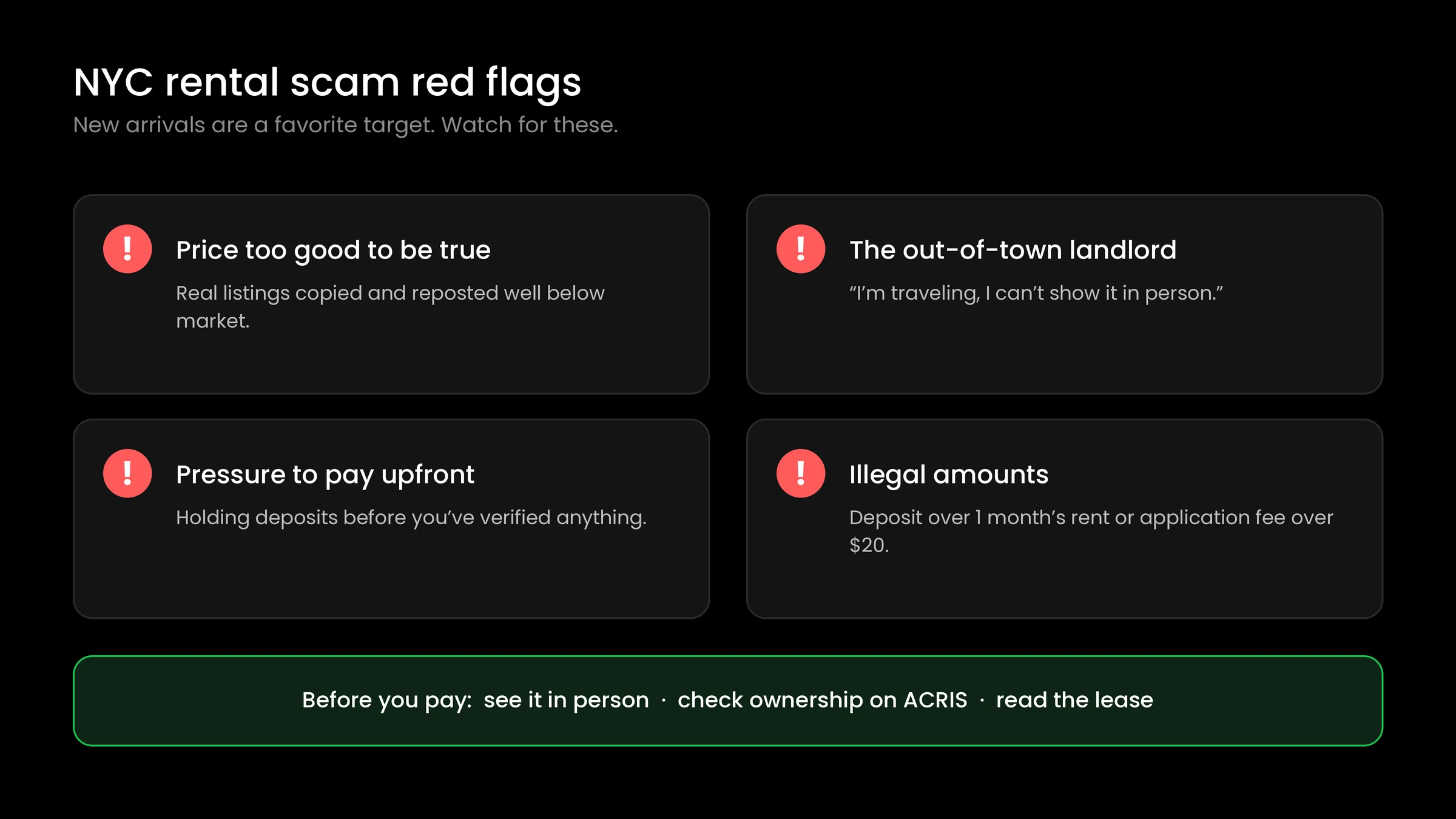
Price too good to be true. Scammers sometimes copy real listings and repost them at well below market price to attract fast replies.
The out-of-town landlord. If someone claims to own the apartment but is traveling or living overseas and cannot arrange an in-person viewing, walk away. Never send money for an apartment you or someone you trust hasn't seen in person or through a verified live video tour.
Pressure to pay upfront. Be cautious of requests for holding deposits, application payments, or other transfers before you've verified the listing and reviewed the lease. Never pay by wire transfer, gift card, crypto or a payment app to someone you haven't verified.
Illegal amounts. Security deposits over one month's rent and application fees over $20 aren't allowed under New York law.
8. Read the entire lease
Before signing, read the entire lease and make sure you understand the following:
Rent, term and renewals. Double-check the exact monthly rent, lease length, and renewal terms and any conditions that could affect future rent increases.
Rent-stabilized status. If the apartment is rent-stabilized, confirm its status and request its rental history from New York State Homes and Community Renewal (HCR) if necessary.
Utility responsibilities. Clarify who pays for heat, water, gas, electricity and any building fees.
Required disclosures. NYC landlords must share the building's bedbug history and state-mandated flood disclosures.
Move-out rules. Understand notice periods, early termination clauses, and how your security deposit will be handled.
Whenever possible, visit the apartment in person, verify the property's ownership through ACRIS, and review the lease before transferring money. If something feels off, walk away. In a city with thousands of listings, there will be another apartment. When you do sign a lease, make sure to take time-stamped photos and videos of every room, including existing damage, on move-in day, and keep a copy for your records.
III. Best NYC neighborhoods for newcomers (and how to choose)
One of the most exciting parts of moving to New York is choosing where to live. But there's no single best neighborhood. The right choice depends on your budget, commute, lifestyle, and the kind of community you want to be part of. Here are some popular neighborhoods worth exploring.
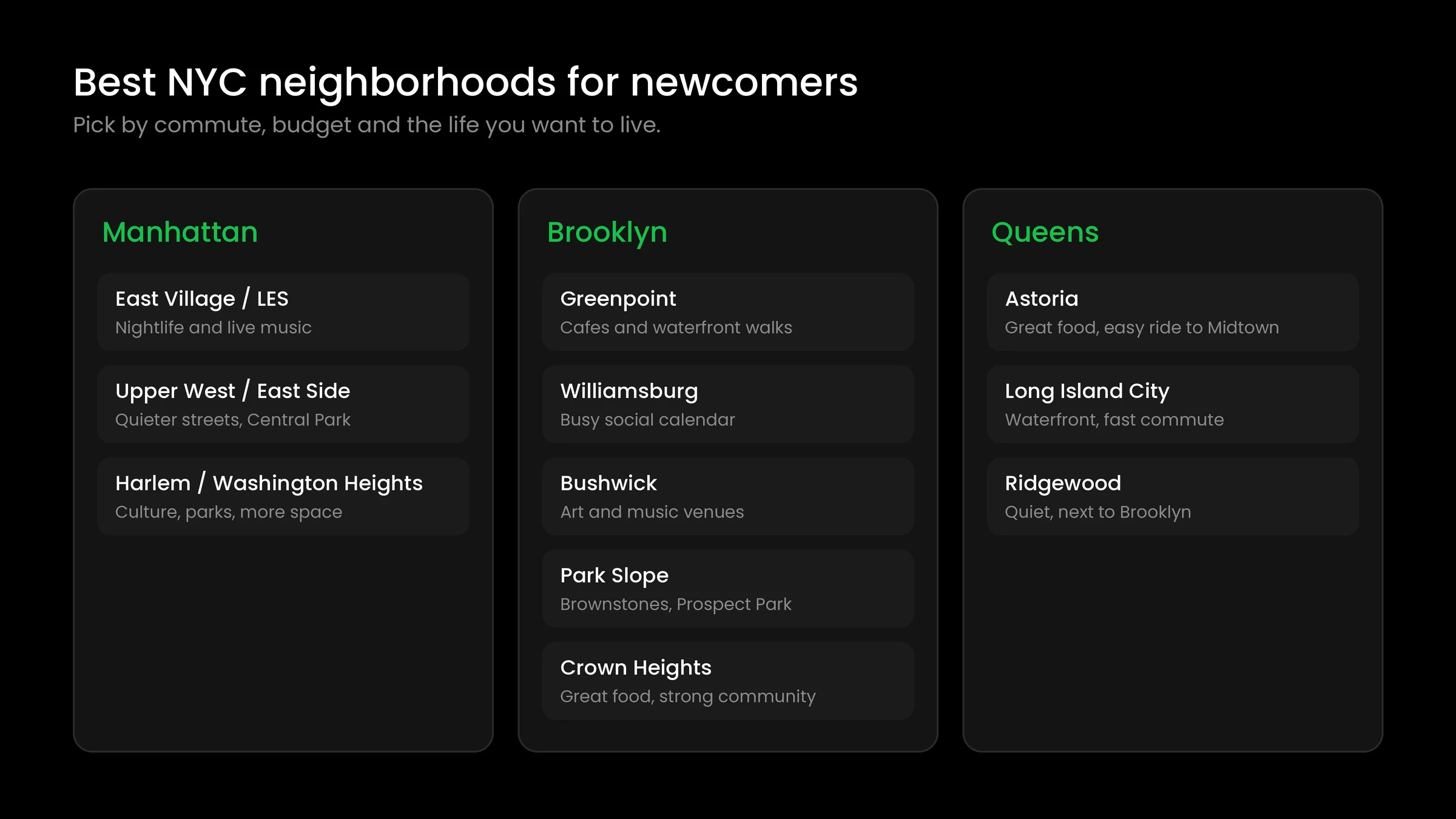
| Neighborhood | Borough | Good for newcomers who want |
|---|---|---|
| Astoria | Queens | Great food, a friendly neighborhood atmosphere, and relatively easy access to Midtown |
| Long Island City | Queens | Modern high-rises, waterfront parks, and convenient Manhattan commutes |
| Ridgewood | Queens | A quieter residential feel with access to Brooklyn's nightlife |
| Greenpoint | Brooklyn | Cafes, parks, waterfront walks and a village charm |
| Williamsburg | Brooklyn | Restaurants, bars, shopping, and an active social calendar |
| Bushwick | Brooklyn | Indie art, music venues, and a vibrant younger creative energy |
| Park Slope | Brooklyn | Historic brownstones, Prospect Park, and a relaxed pace |
| Crown Heights | Brooklyn | Diverse communities, historic architecture, and incredible local dining |
| East Village / Lower East Side | Manhattan | Legendary nightlife, live music venues, and non-stop energy |
| Upper West Side / Upper East Side | Manhattan | Quieter streets, Central Park and established residential communities |
| Harlem / Washington Heights | Manhattan | Rich cultural history, expansive parks, and more square footage per dollar |
Before committing to a neighborhood, spend some time experiencing it as a resident rather than a visitor.
- Test your commute. Take the subway during rush hour. A neighborhood that looks close on a map may involve an inconvenient transfer or a long walk.
- Visit at different times. Walk around during the day, at night, and on weekends. The atmosphere can change significantly.
- Check subway access. Living near more than one train line makes it much easier to get around the city and gives you a backup option if one train is delayed or shut down.
- Explore everyday essentials. Find the nearest grocery store, gym, pharmacy, laundromat, and coffee shop. These places will become part of your daily routine.
- Think about your social life. If you enjoy running, look for neighborhoods near parks and running clubs. If you love going out, consider areas with restaurants, bars, and events within walking distance. If you prefer a quieter lifestyle, look for residential streets with local community spaces.
Your neighborhood isn't just where you sleep. It's where your everyday life happens.
IV. How to prepare for your move to NYC
Once you've chosen your neighborhood and signed the lease, it's time to prepare for the move. Here's how to make moving day easier:
- Hire licensed movers. For moves between states, check the mover's USDOT registration. For moves within New York State, verify that the company is licensed by the New York State Department of Transportation. Get written estimates and compare at least three companies.
- Check move-in rules with your building. Many buildings require a certificate of insurance (COI) from the moving company. You may also need to reserve the elevator, and move within the weekday moving windows.
- Avoid the end of the month if possible. Moving companies get particularly busy around the first and last weekends of each month, especially during summer. Booking early can give you more flexibility.
- Measure everything. NYC apartments often have narrow doorways, staircases, and elevators. Walk-ups are common, too. Measure your furniture before arranging delivery.
- Bring less than you think you need. NYC apartments are small, and it may be cheaper and easier to buy some furniture after arriving than to move everything across the country.
- Pack a first-night bag. Keep sheets, towels, chargers, toiletries, medication, and a change of clothes in a separate bag. You don't want to be digging through boxes at midnight.
Setting up utilities and internet
Try to have your electricity and internet arrangements in place before move-in day so you can settle in without unnecessary interruptions. Check with your landlord to understand which services are included in your rent and which ones you need to arrange yourself.
- Electricity. Con Edison provides electricity across most of NYC. Check your specific address and building arrangements before setting up an account.
- Gas. Gas service depends on your location. Con Edison serves Manhattan, the Bronx, and parts of Queens, while National Grid serves Brooklyn, Staten Island, and parts of Queens. Some buildings include gas, heat, and hot water in the rent.
- Internet. Spectrum, Verizon Fios and Optimum are the main providers, but availability varies by building. Ask the landlord beforehand.
- Renters insurance. Some buildings require renters insurance as a lease condition. Even when it's not required, it's worth considering for protection against theft, damage, and liability. It's usually inexpensive.
V. Living in NYC for the first time: your first week
Your first week should be about learning how the city works and establishing a comfortable routine. You don't have to figure everything out immediately, but a few small steps will make daily life much easier.
Learn how to use the subway. New York's subway system can feel confusing at first. Use OMNY to tap-to-pay for subway and local bus rides. The standard fare is $3 as of 2026. Use the same payment method consistently to benefit from the $35 seven-day fare cap. Remember that uptown generally means north and downtown means south. Express trains skip stops. Download the official MTA app to check routes, service changes and real-time updates.
Update your documents. If you're moving permanently from another US state, you need to exchange your out-of-state driver's license for a New York State license within 30 days. You can register to vote in New York at the same time. Also remember to update your mailing address and important accounts.
Walk the neighborhood. New York is best experienced on foot. Walking helps you discover local restaurants, parks, independent stores, and community spaces you might otherwise miss. Don't rely entirely on Google Maps to understand your neighborhood. Take a different route home, explore a few side streets, and find a local coffee shop where you can become a regular. These small discoveries are often what make a new place start to feel familiar.
VI. How to manage the cost of living in NYC
New York is expensive, but your lifestyle and neighborhood can make a significant difference. Rent is usually the biggest expense. After that come groceries, restaurants, transportation, entertainment, and everyday purchases. Here are a few ways to keep your budget under control:
- Cook at home. NYC has incredible restaurants, but eating out regularly can quickly become one of your biggest expenses. Explore local grocery stores, farmers' markets, and affordable neighborhood food shops and prepare healthy and low-cost meals at home.
- Take advantage of free activities. Central Park, Prospect Park, the Staten Island Ferry, public libraries, street festivals, and community events offer endless entertainment without spending much.
- Use public transportation. Most New Yorkers don't need a car. Between the subway, buses, walking, and cycling, you can get almost anywhere without paying for gas, parking, insurance, and car maintenance.
- Look for neighborhood deals. Many gyms, restaurants, cultural institutions, and community organizations offer introductory discounts or local memberships. It's also worth getting an IDNYC card: the free city ID comes with discounts and free memberships at many museums and cultural institutions.
- Plan for unexpected expenses. Moving costs, furniture, medical expenses, and apartment repairs can add up. Keep an emergency fund rather than spending your entire budget getting settled.
VII. Why NYC feels lonely at first (and how to fix it)
Remember that quiet second weekend? Almost every newcomer hits that wall at some point, even in a city with millions of residents and endless things to do. The problem isn't a lack of people. It's the difficulty of turning encounters into relationships.
College has dorms, classes, and campus activities. Workplaces provide recurring interactions. Hometowns come with family, childhood friends, and established social circles. In New York, adult life rarely puts you in the same room with the same people week after week. You have to build that routine yourself. And making friends takes more time than most people expect.
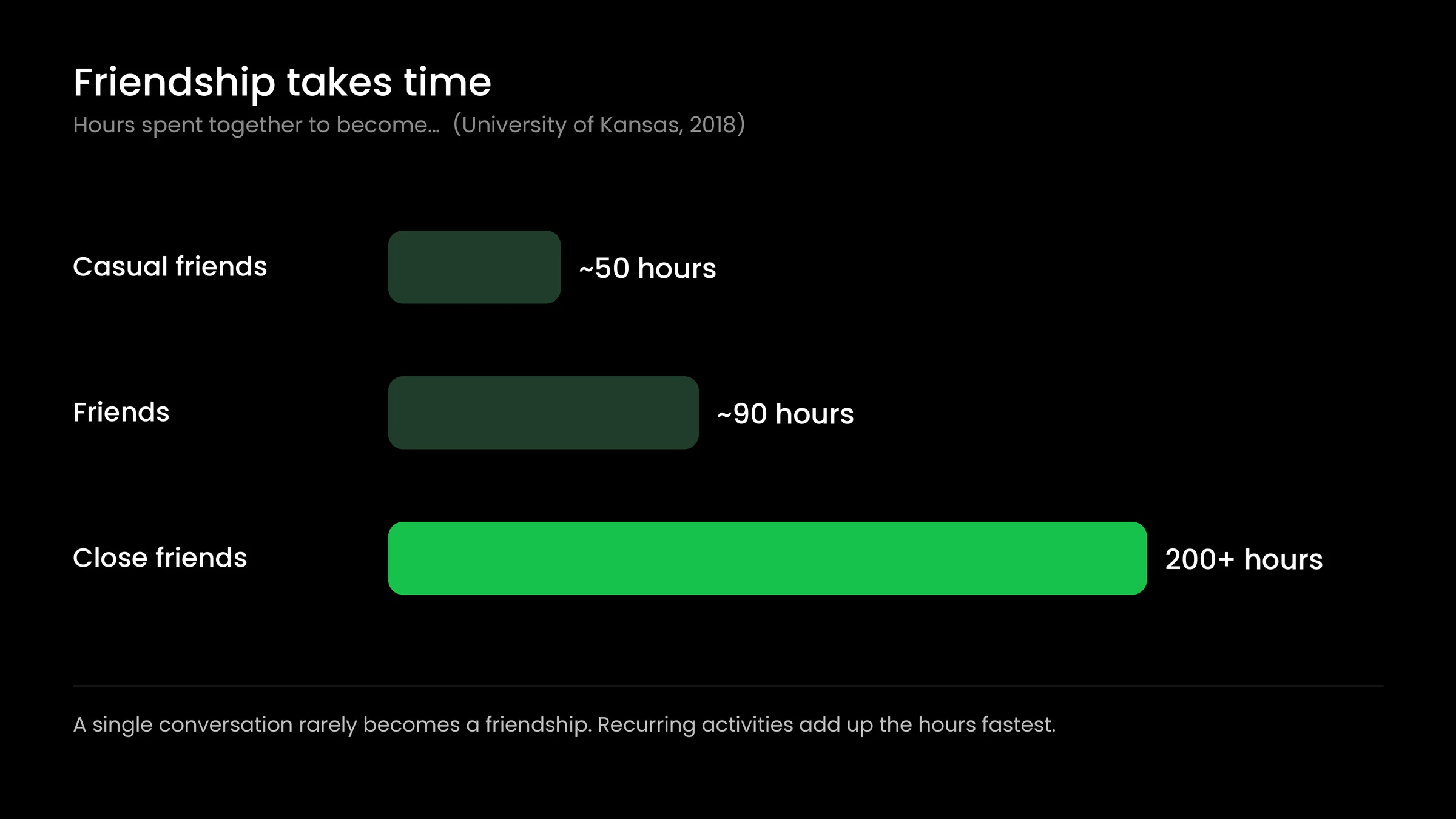
In a University of Kansas study, professor Jeffrey Hall found that developing friendships takes substantial time spent together, around 50 hours to move from acquaintance to casual friendship and more than 200 hours to become close friends. A single conversation at a bar or a coffee shop rarely turns into lasting friendship on its own. It's repeated interactions that matter.
There's another challenge unique to New York: distance. New York is vast. A friend in Astoria and another in Bushwick might be more than an hour apart by public transportation, making spontaneous hangouts difficult. So where do you start?
- Find recurring activities. Join a running club, fitness class, book club, sports league, or hobby group. Seeing the same people regularly makes it easier to build familiarity.
- Become a regular somewhere. Keep going back to that coffee shop you found in your first week. A regular cafe, gym, or community space is where strangers slowly become familiar faces.
- Say yes to invitations. That casual after-work drink or weekend group activity might lead to friendships you wouldn't have found otherwise.
- Make the first move. If you enjoy talking to someone, suggest a specific plan instead of leaving things at "We should hang out sometime."
- Explore beyond your existing circle. Don't limit yourself to people you already know through work or school. Some of your closest friendships may come from shared interests you haven't explored yet.
If you'd rather start with an app, we compared the best apps to make friends, from Meetup to Timeleft.
The good news? Almost everyone around you was once a transplant. Many are still looking for their people, too. You don't need to build an entire social circle overnight. Start with one conversation, one activity, or one familiar face. The rest can grow from there.
VIII. How Anuma helps NYC transplants find their people
New York is full of people looking for new experiences and genuine friendships. You don't have to wait until you've settled in to find them. Anuma Nearby helps you discover who's around, connect over shared interests, and turn chats into real-world plans. Anuma is multiplayer AI for real life, currently live in New York City. While most social apps are designed to keep you scrolling through profiles and content, Anuma uses AI to help turn shared interests and digital conversations into real-world connections. Here's how it works:
You don't start from scratch. Anuma learns your interests from your conversations with AI and the memories you choose to share. It uses that context to help you discover people nearby you might connect with. Instead of approaching every new person with nothing to talk about, you can see what you have in common before starting a conversation.
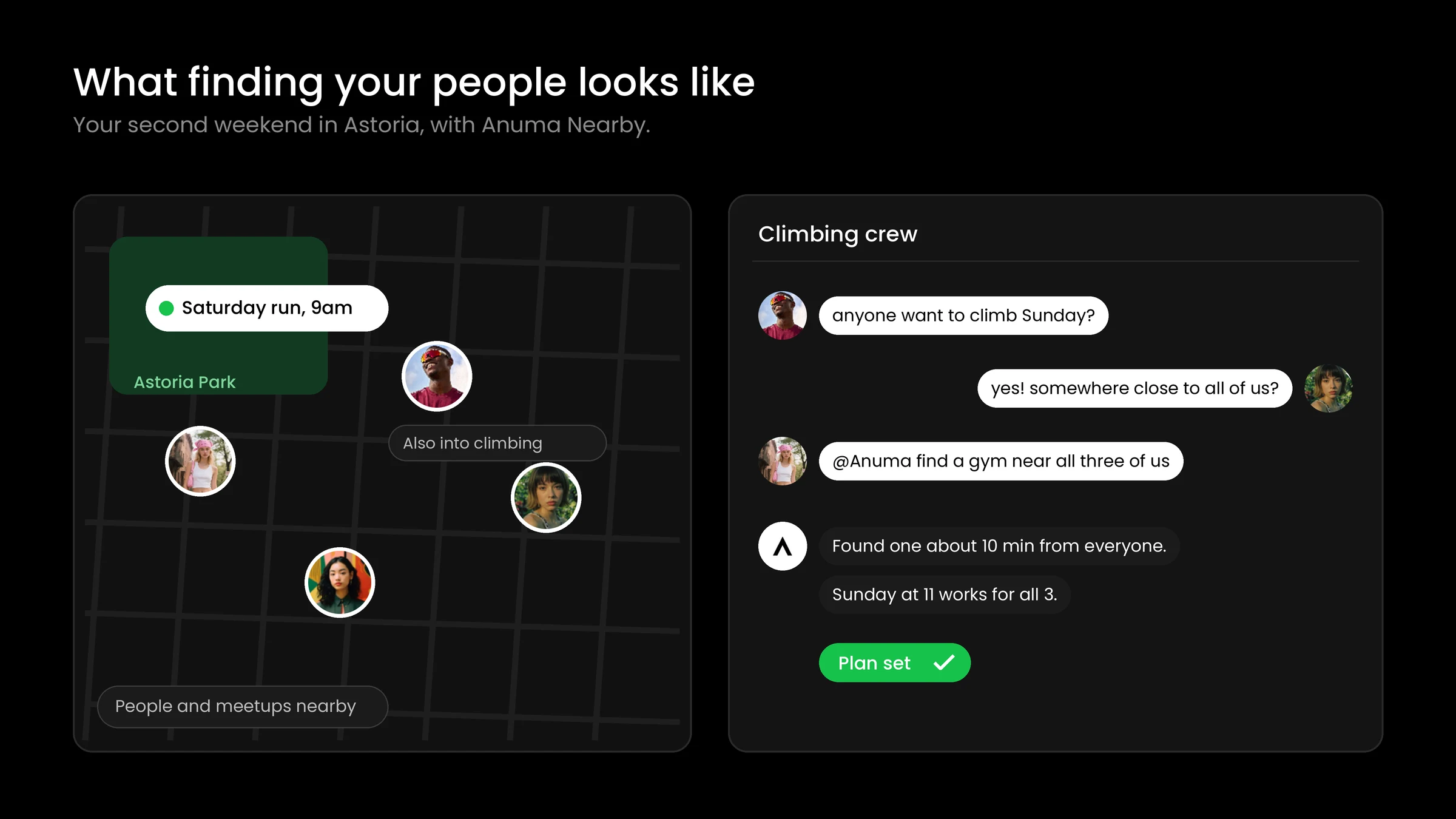
Your neighborhood, mapped live. Anuma's live map shows people and meetups around you. Finding people is only the beginning. Making plans together is what turns introductions into friendships. Tag @Anuma in a group chat to coordinate schedules, find convenient places to meet, and organize activities everyone can enjoy.
What this looks like in real life. Imagine you've just moved to Astoria and don't know anyone. You open Anuma Nearby and discover a Saturday morning running meetup at Astoria Park. You also find a few people nearby who share your interest in climbing. Later, you bring everyone into a group chat and tag @Anuma to help find a climbing gym that's convenient for everyone. Instead of spending another weekend exploring the city alone, you've now found a running group and made plans for the following weekend. That's how a new city starts to feel like home.
Conclusion: Making New York home
Moving to New York requires two plans. The first is practical: understand the rental market, manage your finances, choose the right neighborhood, and learn how to navigate the city. The second is personal: build routines, meet people and find a community. The practical side of moving often gets easier after a few weeks. Building a social life takes longer, which is why it's worth starting on day one.
Anuma Nearby is live in New York City on iOS and Android. Get started at anuma.ai/nearby.
FAQ
Is moving to NYC worth it? For many people, yes. NYC offers careers, culture and people you won't find anywhere else. However, it's expensive and can feel lonely at first. Having a realistic budget and a plan for building your social life can make the transition much easier.
How much money do I need to move to NYC? At minimum, you need your first month's rent, a security deposit of up to one month's rent, moving costs and a cushion for a few months of living expenses. Most landlords also look for yearly income of about 40 times the monthly rent.
Do I have to pay a broker fee in NYC in 2026? Not if the landlord's broker listed the apartment. Under the FARE Act, in effect since June 11, 2025, whoever hires the broker pays the fee. You only pay if you hire your own broker.
How can I avoid rental scams? Never send money before seeing the apartment in person or via a live video. Verify ownership on ACRIS, and remember that deposits over one month's rent and application fees over $20 are illegal in New York.
What are the best NYC neighborhoods for newcomers? It depends on your budget, commute, and lifestyle. Astoria and Long Island City are popular in Queens, while Williamsburg, Greenpoint, and Park Slope offer different lifestyles in Brooklyn. The Upper West Side is another popular option for people who prefer a quieter residential environment.
When is the best time to move to NYC? Summer typically has the most apartment listings but also the highest competition. Late fall and winter may offer more negotiating opportunities, although there are fewer apartments available.
What should I know about living in NYC for the first time? Expect a learning curve: the subway, small apartments and a fast pace. Most people adjust within a few weeks. Building a social life takes longer, so join something recurring in your first month.
What does "NYC transplant" mean? An NYC transplant is someone who moved to New York City from another city, state, or country. The term is commonly used to describe people who weren't born or raised in New York but have chosen to make it their home.
How do I make friends after moving to NYC? Start by joining recurring activities such as running clubs, fitness classes, hobby groups, and local community events. Consistency matters more than attending one-off events. Follow up with people you enjoy meeting and make specific plans to see them again. Anuma Nearby can also help you discover people nearby who share your interests and find activities to do together.
How much is the subway in NYC in 2026? $3 per ride on the subway and local buses since January 4, 2026. Tap with the same card or phone every time and OMNY caps what you pay in any seven-day period.
How much can my landlord raise the rent in NYC? For rent-stabilized leases starting between October 1, 2026, and September 30, 2027, the increase is 0%. For many market-rate apartments covered by Good Cause Eviction, increases above 8.38% in 2026 are presumed unreasonable.