Best Apps to Make Friends in 2026 (8 Compared)
On this page
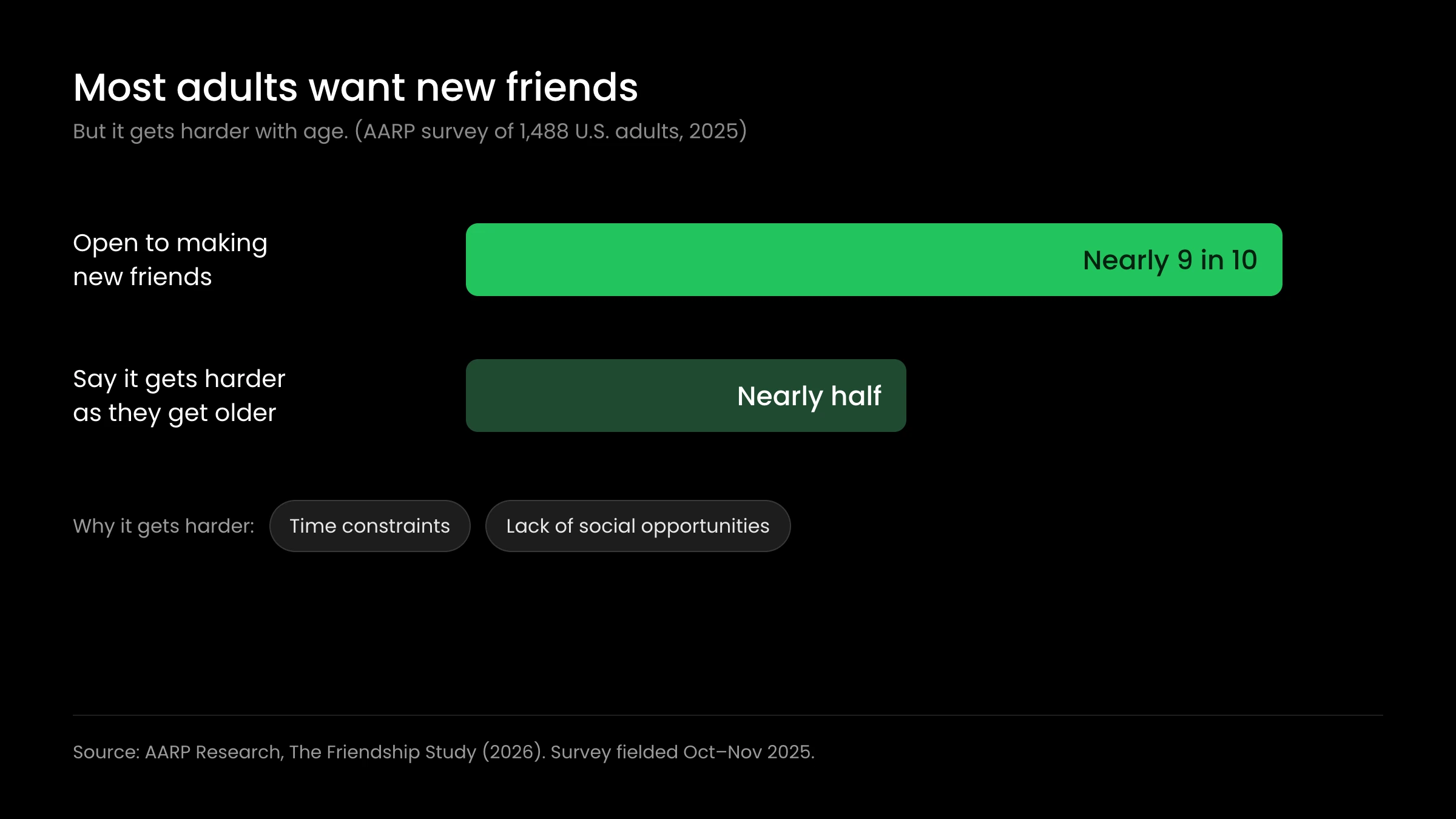
Most adults don't lose touch with friends on purpose, but some move for school or a job, others' schedules drift apart, and one day you realize you can't remember the last time you met with your old friends or made any new friends. School and college put the same people in front of you every day. Adult life rarely does, so you have to build that routine yourself, and it takes longer than most people expect. In a 2025 AARP survey, nearly nine in ten adults said they're open to making new friends, but nearly half said it gets harder as they get older, mostly for lack of time and social opportunities.
That's the gap friend apps try to fill. They help with the hardest first step: finding people worth meeting. But they work in very different ways. Some start with profiles and chats. Others put you at a dinner table or in a run club from day one.
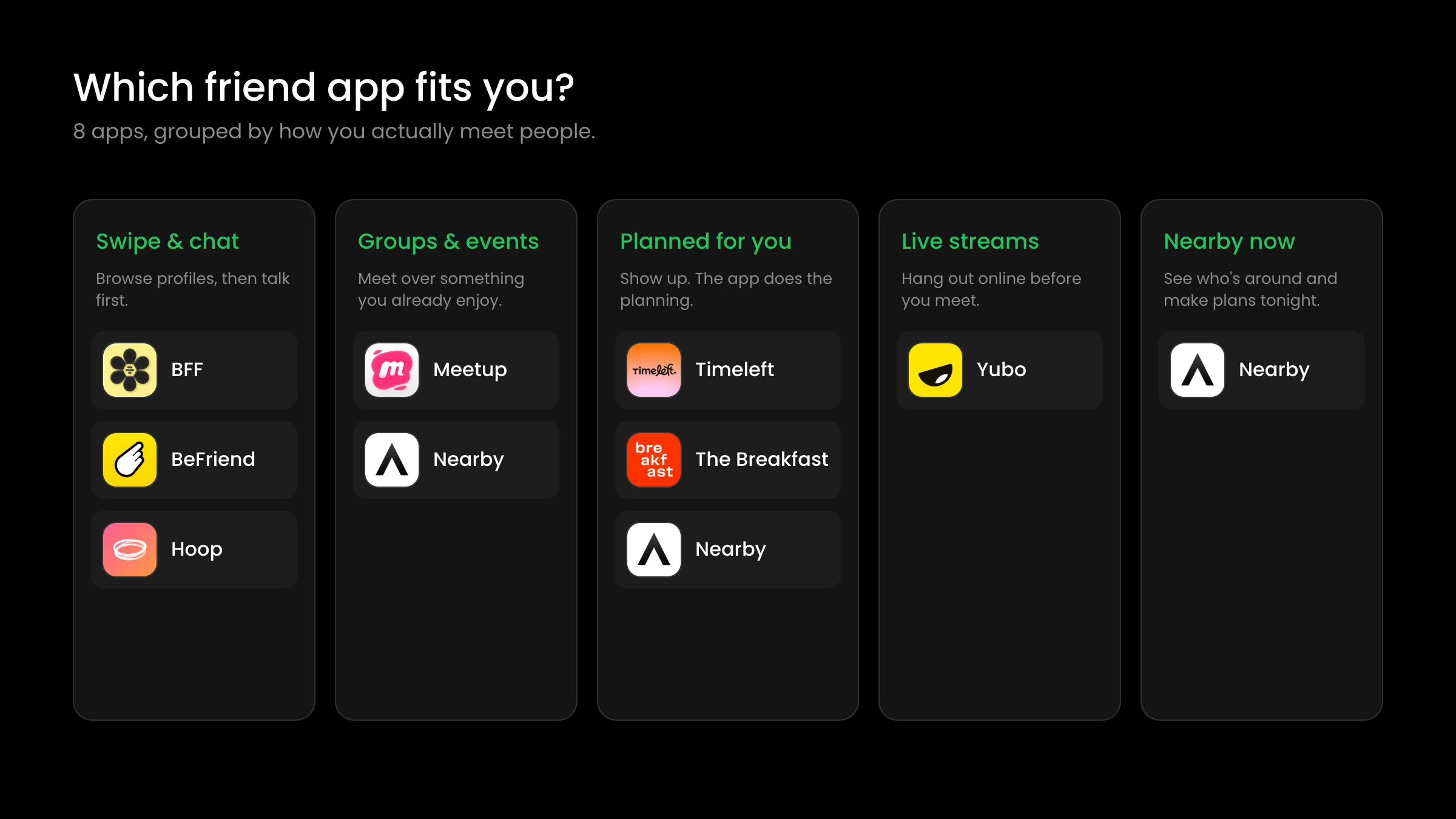
So the best app to make friends depends on how you like to meet people. BFF (formerly Bumble For Friends) is for people who like swiping through profiles. Meetup helps you find people who share your interests. Timeleft puts you at a dinner table with five strangers. BeFriend, Yubo and Hoop are built for chatting first. The Breakfast introduces you to someone new for a one on one conversation. And if you're in New York, Nearby by Anuma helps you discover people who are around you right now.
Full disclosure: We make Nearby by Anuma, so it's included in this list. We've tried to be fair about every app below, including where others do better than we do. Anuma is currently only live in NYC, but will open up in the SF Bay Area in December.
The 8 best apps to make friends in 2026
Here's how each app works, who it's best for, and where it falls short.
1. Nearby by Anuma
Best for: meeting people who are actually around you, without the dating-app feel. NYC only for now.
Nearby is multiplayer AI for real life from Anuma, and it launched in NYC on iOS and Android in September 2026.
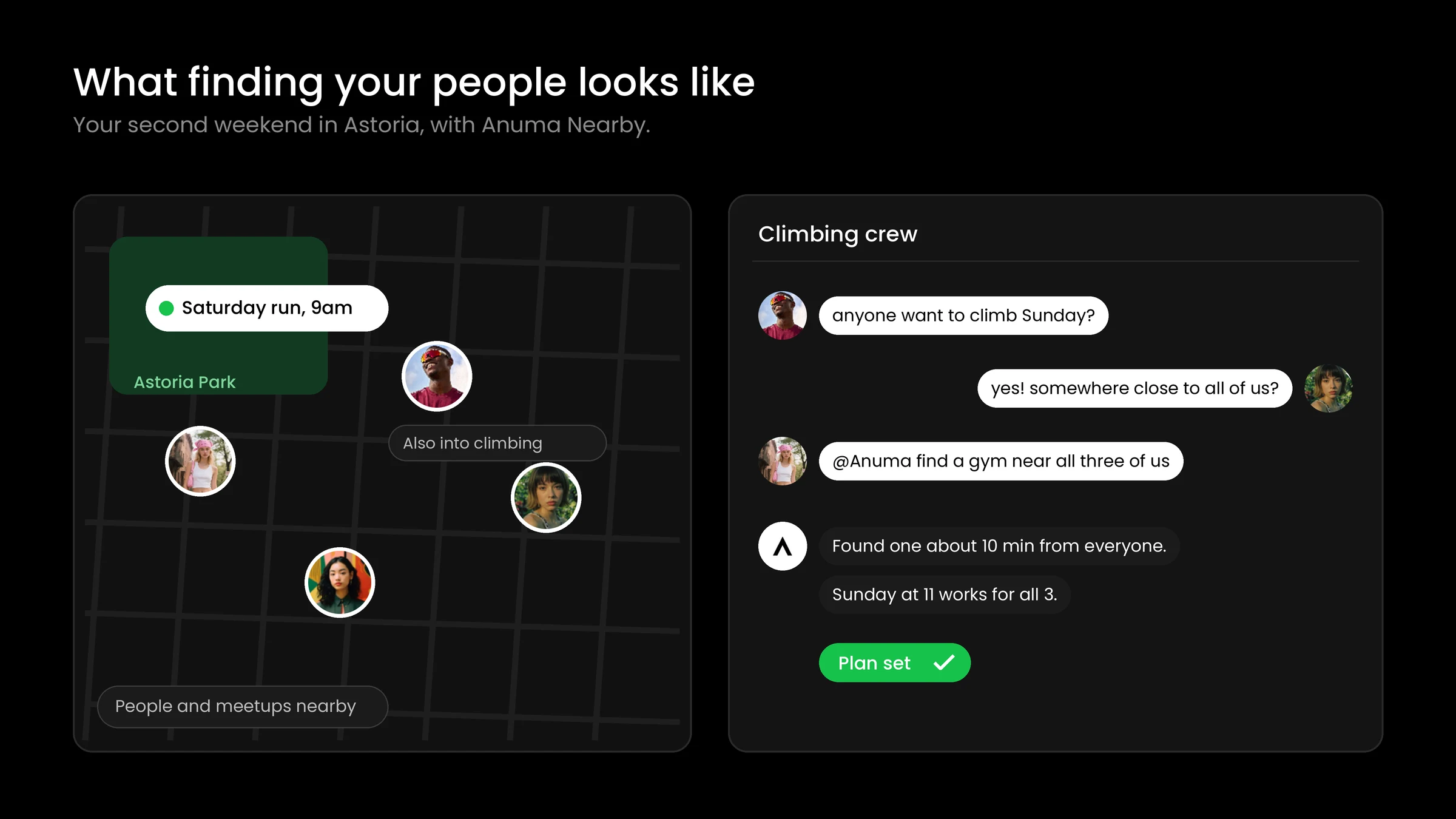
Anuma Nearby takes a different approach to making friends. Instead of spending your evenings swiping through profiles, it shows a live map of who's around, tells you who nearby that you might get along with, and lists meetups you can join to make plans in real life.
What makes it different is your profile. You start with interests and photos. The more you use Anuma, the better it understands you, so your suggestions get better over time instead of staying stuck on a bio you wrote once.
- Pros: real-time and location-based, so plans can happen tonight. Matches get smarter with use. Built for friendship, not dating. Free right now, with no ads and no paid plans.
- Cons: NYC only for now. It's new, so the community is still growing.
- Privacy: Nearby is opt-in. You choose what Anuma remembers and what chats are visible as part of your profile.
2. BFF (formerly Bumble For Friends)
Best for: people who like a familiar swipe-and-chat format.
BFF grew out of the BFF mode inside Bumble's dating app and is now its own app, separate from dating. In the US, Bumble relaunched it in 2025 under the BFF name, replacing the earlier Bumble For Friends app. If you've ever used a dating app, you already know how it works: browse profiles, find people who seem interesting, and start a conversation.
Bumble has recently pushed it toward groups and community, adding group chats, meetups and an in-app calendar.
- Pros: big user base and a format most people already know. Free to use, with paid upgrades.
- Cons: profile browsing can feel like dating-app fatigue all over again. Lots of matches never turn into plans.
3. Meetup
Best for: hobbies and recurring groups.
Meetup is the long-standing option for interest-based groups, from run clubs to language exchanges to tech talks. Most cities have groups for almost everything, and NYC has more than most.
Rather than relying on a single introduction, Meetup gives you a reason to see the same people week after week. That's where lasting friendships tend to come from.
- Pros: huge variety of activities. You can connect over something you already enjoy. Recurring groups let you see the same faces and build friendships slowly.
- Cons: quality varies a lot by organizer. Some events are welcoming and well organized, while others can feel more like a crowd of strangers. Some events are free, while others charge a fee, and a paid Meetup+ subscription unlocks extra features.
4. Timeleft
Best for: people who want a plan made for them.
If the idea of planning anything after work sounds exhausting, Timeleft does it for you. Timeleft matches you with five strangers for dinner at a partner restaurant, usually on Wednesday nights. You answer a personality quiz, pay for a ticket or membership, and pay for your own meal. It runs in many cities and has been in NYC since March 2024.
- Pros: zero planning, and the restaurant and ice-breakers do the work. Great if you're new to a city.
- Cons: fixed format and schedule. Costs add up between tickets and dinner. Group chemistry is luck of the draw.
5. BeFriend
Best for: swiping through people nearby and chatting first.
BeFriend (formerly Swipr) works like a swipe app for friendship. You browse profiles of people near you, swipe on the ones you like, and chat when it's mutual. You can connect your social accounts so new friends can find you elsewhere.
- Pros: quick to start and free to use.
- Cons: a paid subscription unlocks the extras, and some reviewers complain about ads. Conversations tend to stay online.
6. Yubo
Best for: Gen Z adults who like hanging out on live streams.
Yubo mixes swiping with live streams, where you can chat, play games and hang out with up to 10 people at a time. Since late 2025 it has been 18+ only, with age checks through a live selfie.
- Pros: free, social and low-pressure, with lots of ways to talk before you meet. Age verification for everyone.
- Cons: built around being online together, so it takes extra effort to turn a stream into a real-life plan.
7. Hoop
Best for: adding new friends on Snapchat.
Hoop shows you profiles one at a time. If you both say yes, you swap Snapchat usernames and keep talking there. Requests cost "diamonds," an in-app currency you can earn by using the app or buy.
- Pros: simple and fast if you already live on Snapchat. Your username stays private until you accept a request.
- Cons: it's rated 12+ on the App Store, so many users are teens. Friendships stay on Snapchat unless you make a plan, and the diamond system limits how many requests you can send.
8. The Breakfast
Best for: one-on-one conversations with someone new.
The Breakfast introduces you to one new person a day, and you have 24 hours to decide whether to meet for breakfast. You apply to join, and it's a paid membership with no free trial.
It's a slower, more intentional approach. Instead of browsing endless profiles, you get one introduction and a real conversation over breakfast.
- Pros: intentional and low-pressure, with no swiping. Good for curious people who like one-on-one chats.
- Cons: one introduction a day is slow. Membership is paid. Check whether it's live in your city before signing up.
Which friend app is right for you?
There's no single best app. If small talk over text drains you, skip the swipe apps and book a dinner. If you like getting to know someone before you meet, start with a chat app. If your schedule changes every week, look for something that works tonight.
| App | How you meet | Best for | Cost |
|---|---|---|---|
| Nearby by Anuma | Live map and vibe check, then meet IRL | Spontaneous plans with people close by | Free, no ads (NYC only) |
| BFF | Swipe, chat, groups | A familiar dating app format | Free, paid upgrades |
| Meetup | Interest groups and events | Hobbies and recurring groups | Free, paid Meetup+ and some paid events |
| Timeleft | Set dinner with 5 strangers | Zero planning | Paid ticket or membership, plus your meal |
| BeFriend | Swipe people nearby, then chat | Chatting before you meet | Free, paid subscription |
| Yubo | Swipes and live streams | Gen Z adults who like to hang online | Free, paid extras |
| Hoop | Mutual yes, then Snapchat | Growing your Snapchat friends | Free, paid diamonds |
| The Breakfast | One intro a day, breakfast 1:1 | Low-pressure conversations | Paid membership |
Free apps to make friends
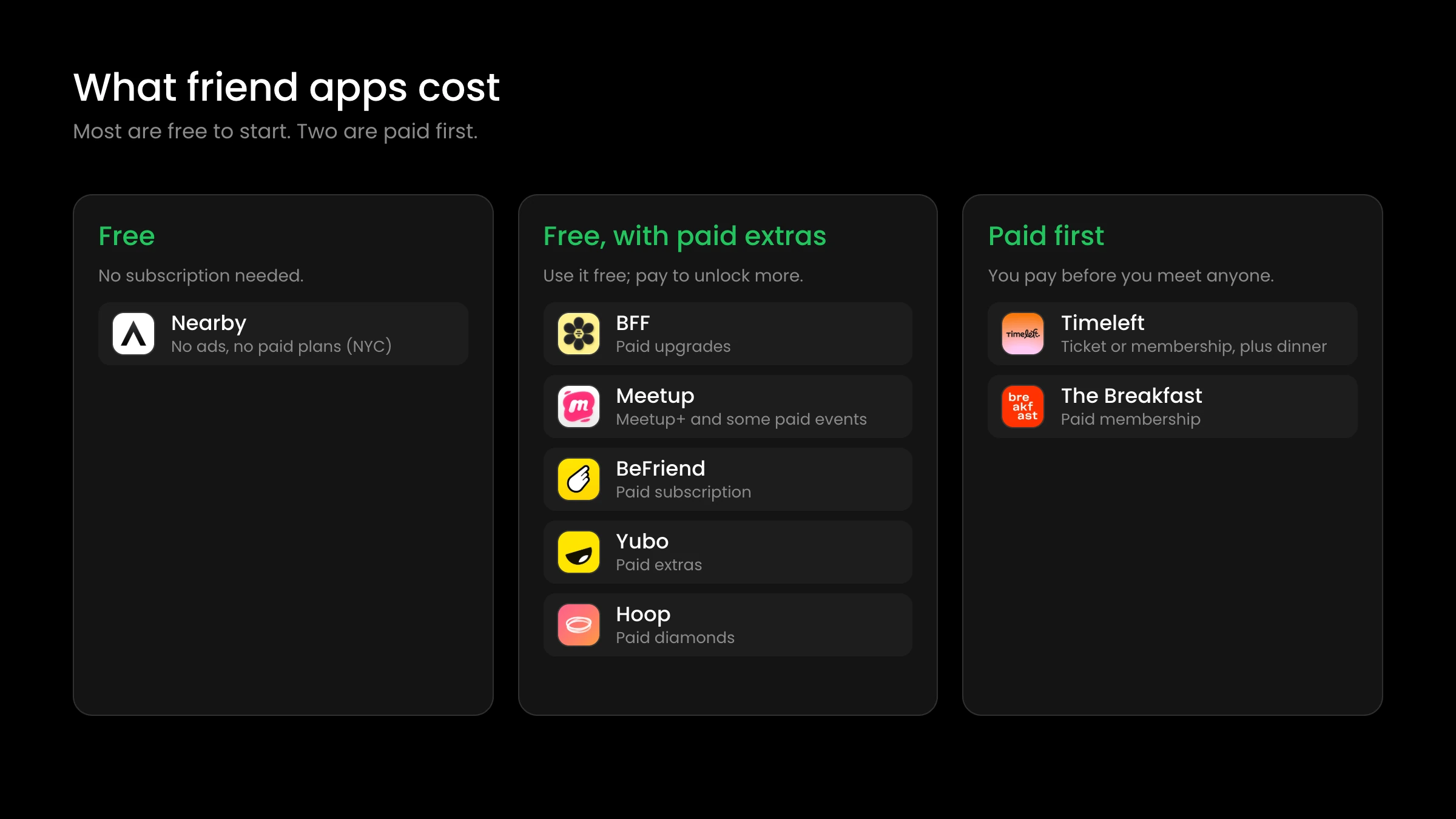
If you'd rather not pay at all, Nearby is the only app on this list with no paid plans right now, and it has no ads, though it's NYC only for now. BFF, Meetup, BeFriend, Yubo and Hoop are free to use, with paid extras that are easy to skip, and most Meetup events cost nothing. Timeleft and The Breakfast are the only paid-first options on this list.
Apps to make friends near me
Distance matters more than most people think. A friend who lives ten minutes away is far easier to see every week than one across town. If you want friends close by, look for apps built around location. Nearby shows a live map of people and meetups around you in NYC. BFF and BeFriend show profiles of people nearby. Meetup lists groups and events in your area, so you can meet people in person from the start.
Best apps to make friends in NYC
Every app on this list works in New York. If you're here, start with Nearby for spontaneous plans close to you, Timeleft for a planned dinner, and Meetup for a recurring group. Just moved? Our Moving to NYC guide covers finding an apartment, picking a neighborhood and building a social life from day one.
How to turn app matches into real friends
Whichever app you choose, meeting people is only half the challenge. In a University of Kansas study, it took around 50 hours together to go from acquaintance to casual friend, and more than 200 hours to become close friends. A single great conversation rarely gets you there. Repeated time together does.
Make plans sooner rather than later. If you hit it off with someone, suggest a specific time and place instead of letting the conversation drag on for weeks.
Show up more than once. Seeing the same people regularly is one of the easiest ways to build familiarity and trust. A weekly run club or book group may do more for your social life than attending five unrelated events.
Don't rely on just one approach. Try a friend app for meeting new people, then find a recurring activity where you can get to know them over time.
Give it a little time. Not every conversation will turn into a friendship, and that's normal. The goal isn't to click with everyone. It's to find a few people you genuinely enjoy spending time with.
FAQ
Are there apps to make friends?
Yes. BFF (formerly Bumble For Friends), Meetup, Timeleft, BeFriend, Yubo, Hoop, The Breakfast and Anuma Nearby are all apps for making friends. They differ in how you meet: swiping profiles, joining groups, booking a dinner, or seeing who's nearby right now.
What is the best free app to make friends?
In New York, Anuma Nearby is free, with no ads or paid plans right now, and shows people and meetups around you in real time. Elsewhere, BFF, Meetup, BeFriend, Yubo and Hoop are free to use, with optional paid extras.
What happened to Bumble BFF?
In the US, Bumble relaunched its friend-finding product in 2025 as a standalone app called BFF, replacing BFF mode and the Bumble For Friends app. It adds group chats, meetups and an in-app calendar.
What is the best app to make friends in NYC?
It depends on your style. Anuma Nearby is best for meeting people around you in real time, BFF for swiping, Timeleft for planned dinners, Meetup for hobby groups, and The Breakfast for one-on-one chats.
Is there a friend app that isn't a dating app?
Yes. Nearby, Timeleft, Meetup and The Breakfast are all built for friendship. BFF is a separate app from Bumble's dating app. Each has a different way of bringing people together.
How do I make friends after moving to a new city?
Pick one recurring activity, like a run club or class, and one app for spontaneous plans. Showing up regularly matters more than meeting lots of people once.
Is Anuma Nearby available outside NYC?
Not yet. Anuma Nearby is live in New York and opens in the SF Bay Area in December. If you're in another city, you can join the waitlist to hear about future availability.
Can other people see my Anuma chats on Nearby?
Your private chats stay private. In public mode, summaries of your public-mode chats can appear on your Nearby profile under Activity. You choose what Anuma remembers and which memories you make public.
Conclusion: The app is only the first step
A friend app can introduce you to someone. It can't make you friends. That part happens when you suggest a plan, show up, and do it again the next week.
So pick one app that fits how you like to meet people, pair it with one recurring activity, and give it a few months. The hardest part of making friends isn't finding people. It's turning a good conversation into an actual plan. In New York, Anuma Nearby shows you who's around and who you'll click with, so the next step is just saying hi.