Multiplayer AI vs Multi-Agent AI: Interaction vs. Execution
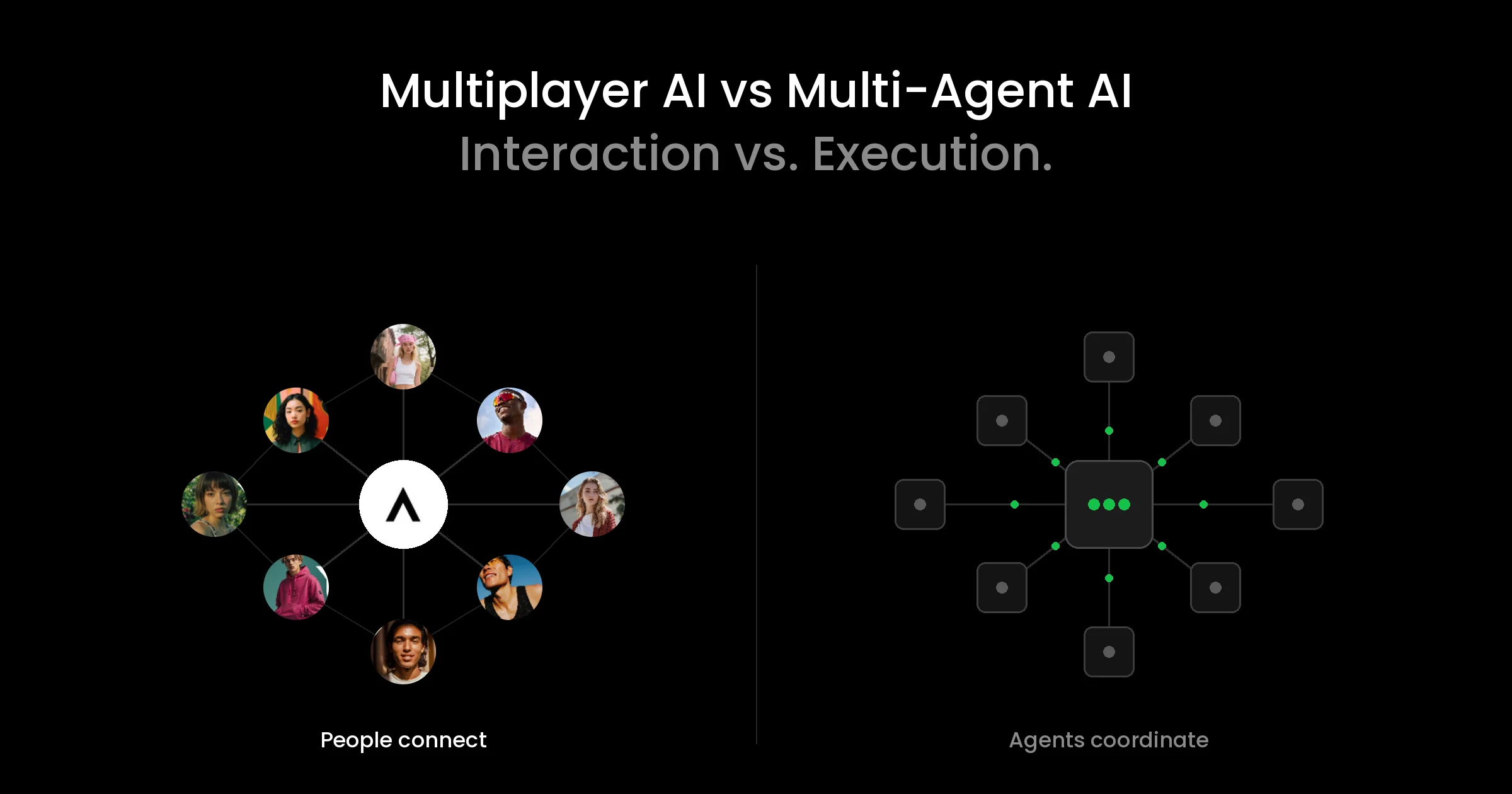
AI is becoming more collaborative. Some products bring people together to interact with AI. Others use multiple AI agents to get work done. Because both involve more than one participant, multiplayer AI and multi-agent AI are often confused.
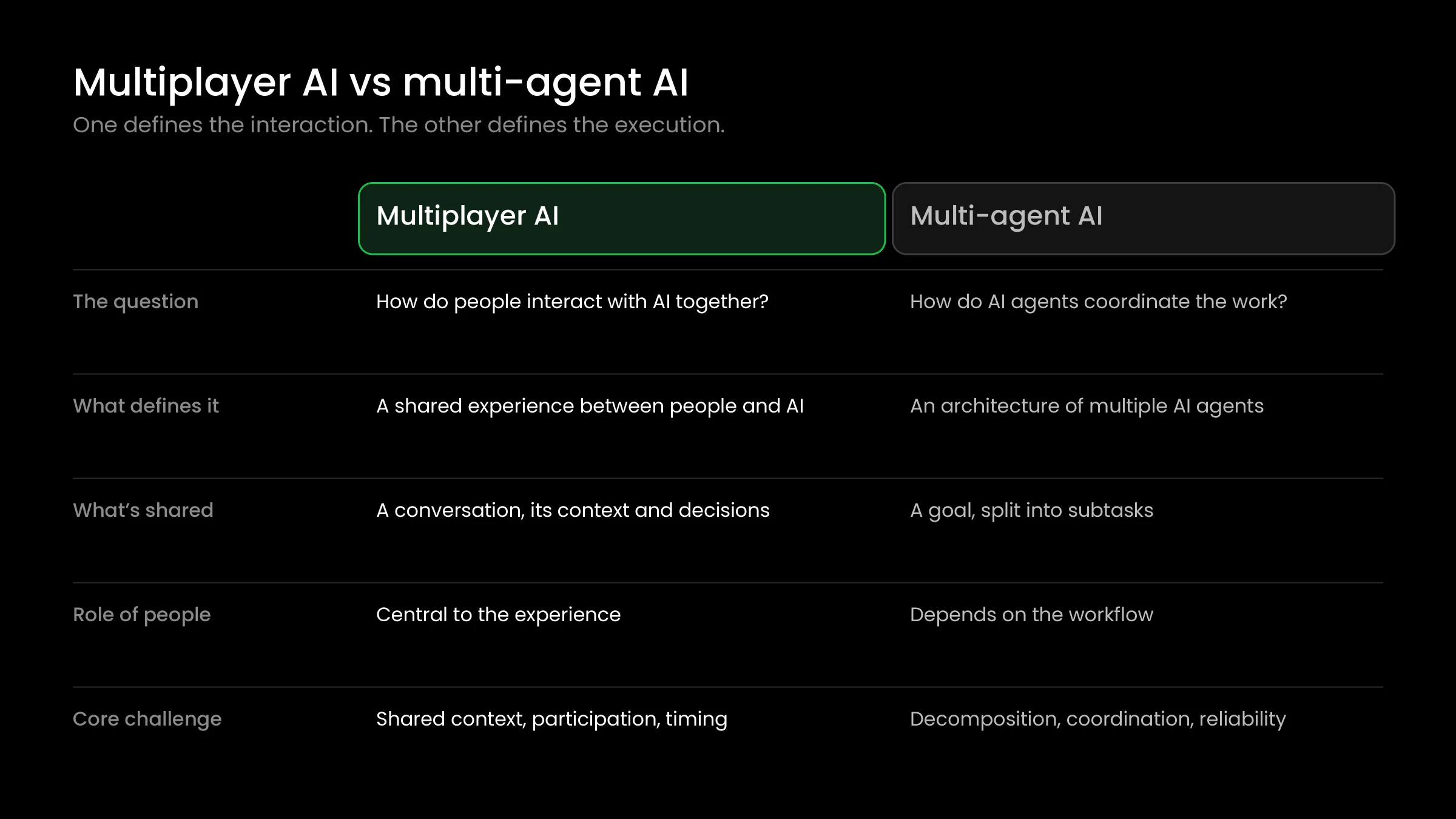
The key difference is who is being brought together. Multiplayer AI brings people and AI together in a shared experience. Multi-agent AI brings AI agents together to coordinate the work. Multiplayer is a product category, focused on the interactive experience. Multi-agent is a build choice, focused on how AI agents execute tasks.
A multiplayer app does not necessarily require multiple AI agents, and a multi-agent product does not necessarily support collaboration between people.
What Is Multiplayer AI?
Multiplayer AI is the counterpart to single player AI. Instead of one person interacting with one chatbot alone, multiple people interact with the same AI in a shared space, with shared context and a common goal. Multiplayer AI focuses on the human experience. Participants can contribute information, exchange ideas, make decisions, and make progress as a group, with AI as part of the interaction rather than a separate tool each person uses on their own.
What Is Multi-agent AI?
Multi-agent AI is the counterpart to single agent AI. Instead of one single agent handling a request from start to finish, multiple AI agents coordinate to complete a task. The focus is on execution. Agents may specialize in different parts of a problem, with an orchestrator breaking a complex task into smaller subtasks and delegating work to the appropriate agents.
For example in a travel planning app, one agent might research destinations, another compare prices, and a third compiles the itinerary. The user may only see the final recommendation. The coordination happens behind the scenes.
Two Different Layers of AI Collaboration
Multiplayer AI and multi-agent AI are not competing approaches. They describe different layers of a product, and they can work together.
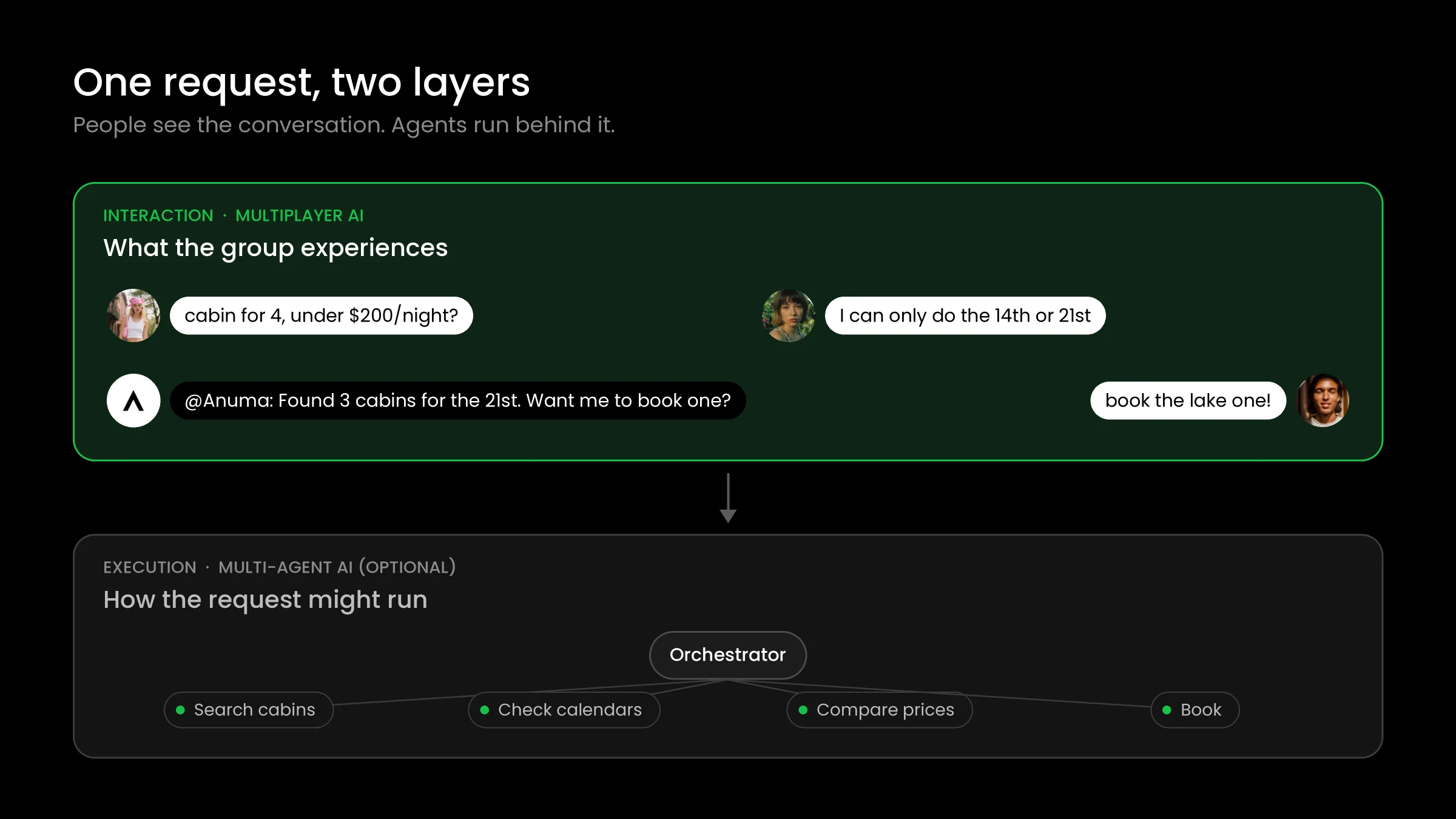
Imagine four friends planning a weekend getaway in a shared messaging channel. One person prompts: "@AI, help us find a cabin for four, under $200 a night, on a weekend that works for everyone."
In a multiplayer AI experience, everyone can join the conversation, share preferences, add constraints, and respond to suggestions. The AI keeps track of the group's shared context and helps everyone move toward a decision. It is not simply answering four separate questions. It is helping the group make progress together. The challenge is interaction design: understanding what context should be shared, respecting individual preferences and permissions, knowing when to contribute, and helping the group reach a decision without taking over the conversation.
Behind the scenes, the app could use a single AI agent to handle the request, or coordinate multiple specialized agents to research destinations, compare availability, and assemble options. Either approach can power a multiplayer experience. The challenge for multi-agent AI is different: how to divide work effectively, coordinate agents, evaluate their outputs, and make the overall system reliable.
The Four AI Product Experiences
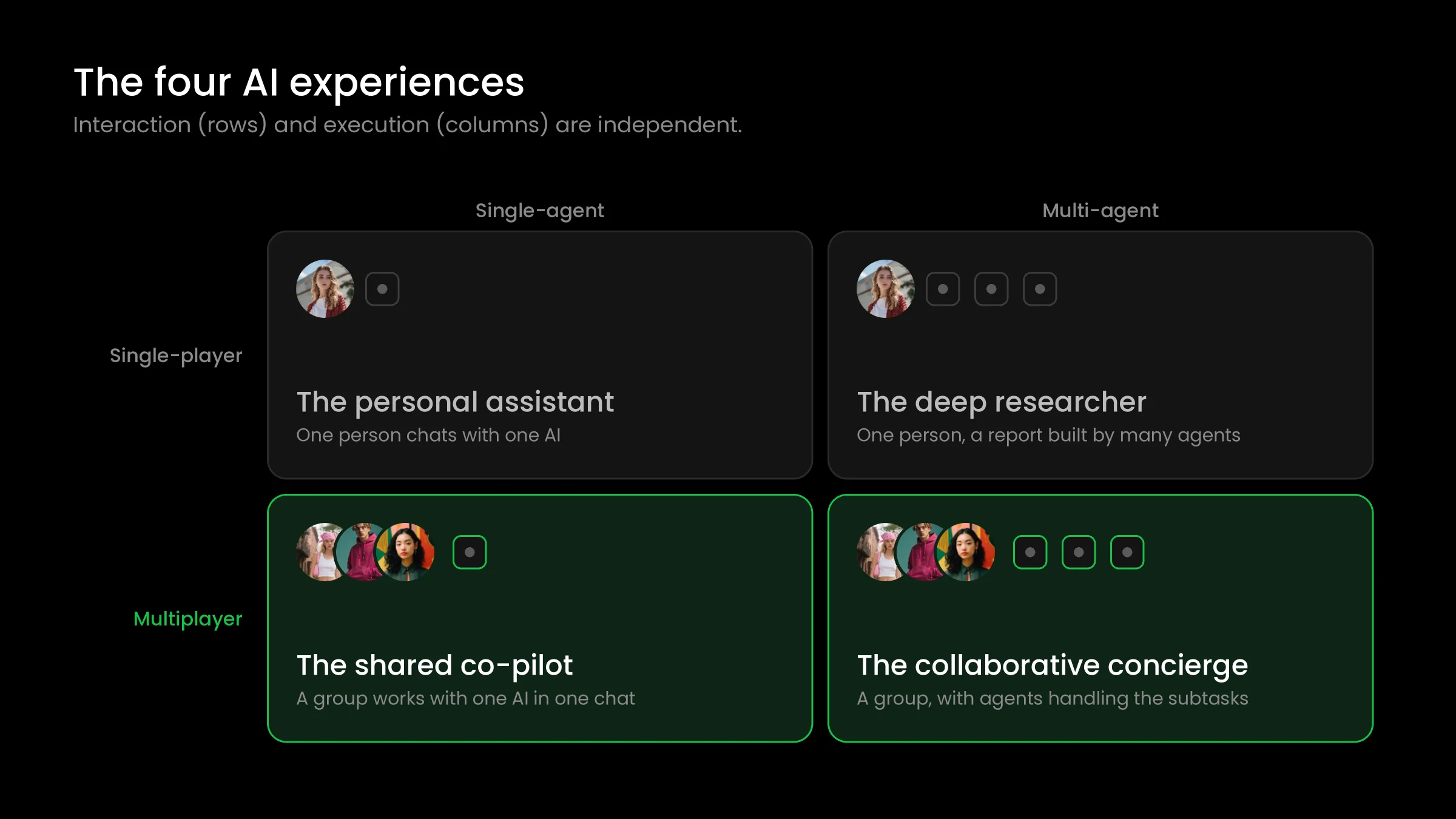
Because the interaction and execution choices are independent, AI products can combine them in four different ways and create different product experiences.
- The personal assistant (single-player, single-agent): One person chats with one AI assistant. This is the classic one-on-one chat app most people use every day, asking ChatGPT or Claude to rewrite an email, brainstorm gift ideas, summarize an article, or draft a quick grocery list. A single user talks directly to a single model, and the conversation remains a private, back-and-forth dialogue from start to finish.
- The deep researcher (single-player, multi-agent): One person requests a complex task and the specialized AI agents coordinate behind the scenes to execute it. For example, asking Perplexity Deep Research or an engineering tool like Devin to conduct market research and build a comparison web page. While the user waits, the AI agent breaks the prompt down, and the specialized agents coordinate to finish the task.
- The shared co-pilot (multiplayer, single-agent): A group interacts with one AI assistant in a shared conversation. For example a team tags an AI bot inside a Slack or Discord channel to summarize a long thread, answer group questions, or log decisions.
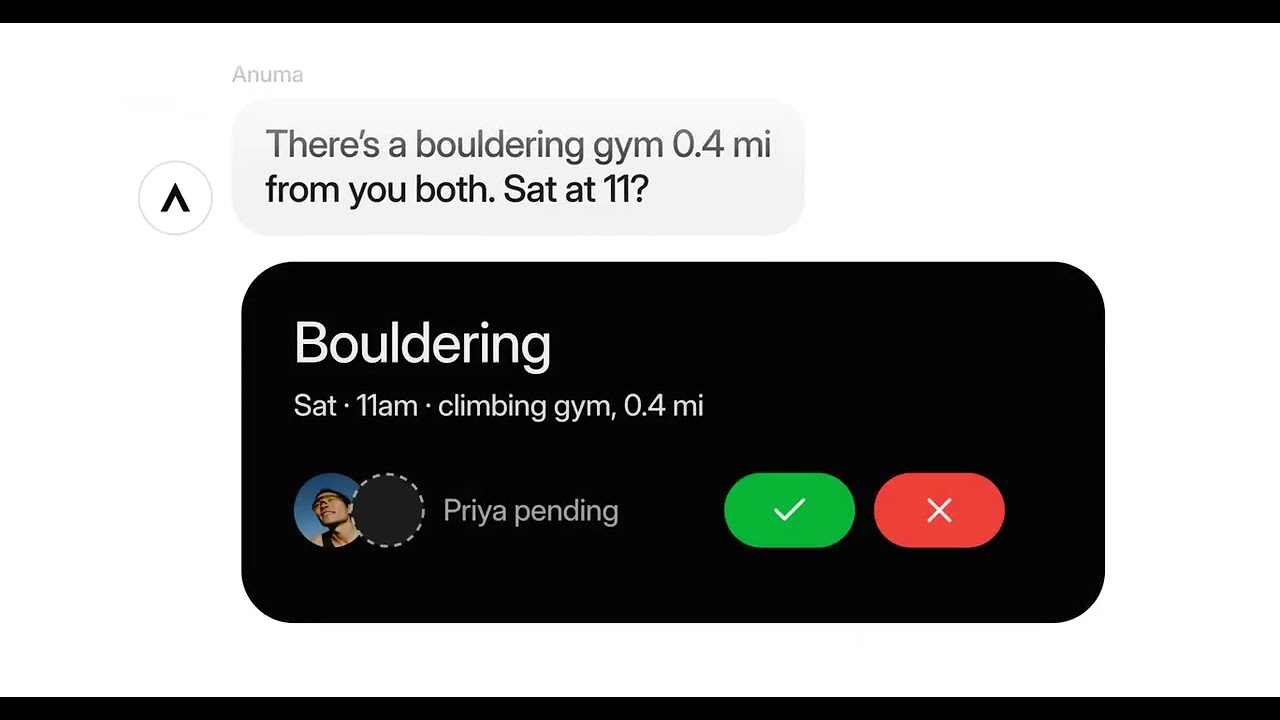
- The collaborative concierge (multiplayer, multi-agent): A group of people collaborates inside a shared workspace powered by multiple specialized agents running in the background. For example, Anuma coordinates multiple specialized functions in a group chat, evaluating proximity and vibe checks across individuals, discovering venues, aligning multiple calendars, and reserving spots. Instead of executing a single prompt, it orchestrates background subtasks to serve the collective goals of the group.
These are just different product experiences, not a ranking of product quality. Adding more agents does not automatically make a product better. The framework does, however, help answer three questions:
- When choosing an AI product: Can people collaborate with AI in the same shared context, or must everyone work in a separate conversation?
- When building an AI app: Are you designing how people interact with AI together, how agents coordinate tasks, or both?
- When understanding the AI landscape: Is a product changing the way people experience AI, the way AI executes work, or both?
What Makes a Great Multiplayer AI Product?
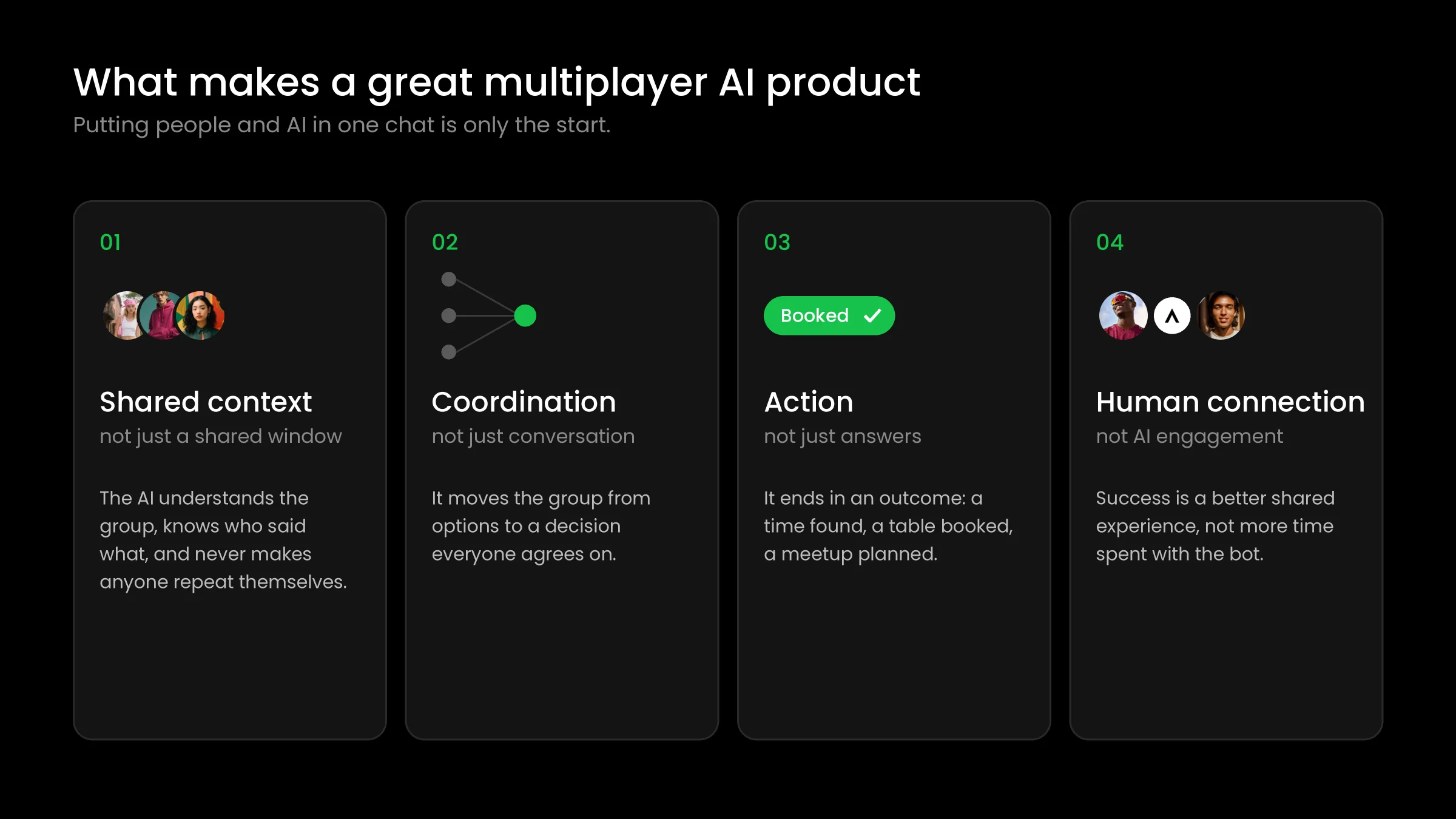
Just putting multiple people and AI in the same chat is not enough. A genuinely useful multiplayer AI experience needs to help the group make progress. Four principles matter:
- Shared context, not just a shared chat window. A group conversation is more than several individual conversations stacked together. People have different preferences, constraints, and knowledge. AI should understand the group's context, recognize individual contributions, and avoid making people repeatedly explain information.
- Coordination, not just conversation. AI can summarize discussions and generate suggestions, but a group needs help moving from possibilities to decisions: comparing options, resolving constraints, and agreeing on what happens next.
- Action, not just answers. Effective multiplayer AI products help turn conversation into action: a meeting time found, a restaurant booked, or a meetup planned. The goal is not just to generate a recommendation, but to help people do something with it.
- Human connection, not just AI engagement. The goal of multiplayer AI is not to maximize the amount of time spent talking to a bot. It is to make collaboration easier and human connection stronger. At work, that means less time spent coordinating and more time solving problems together. In everyday life, it can help reduce planning fatigue so people have more time and energy for each other.
Multiplayer AI vs. Social AI
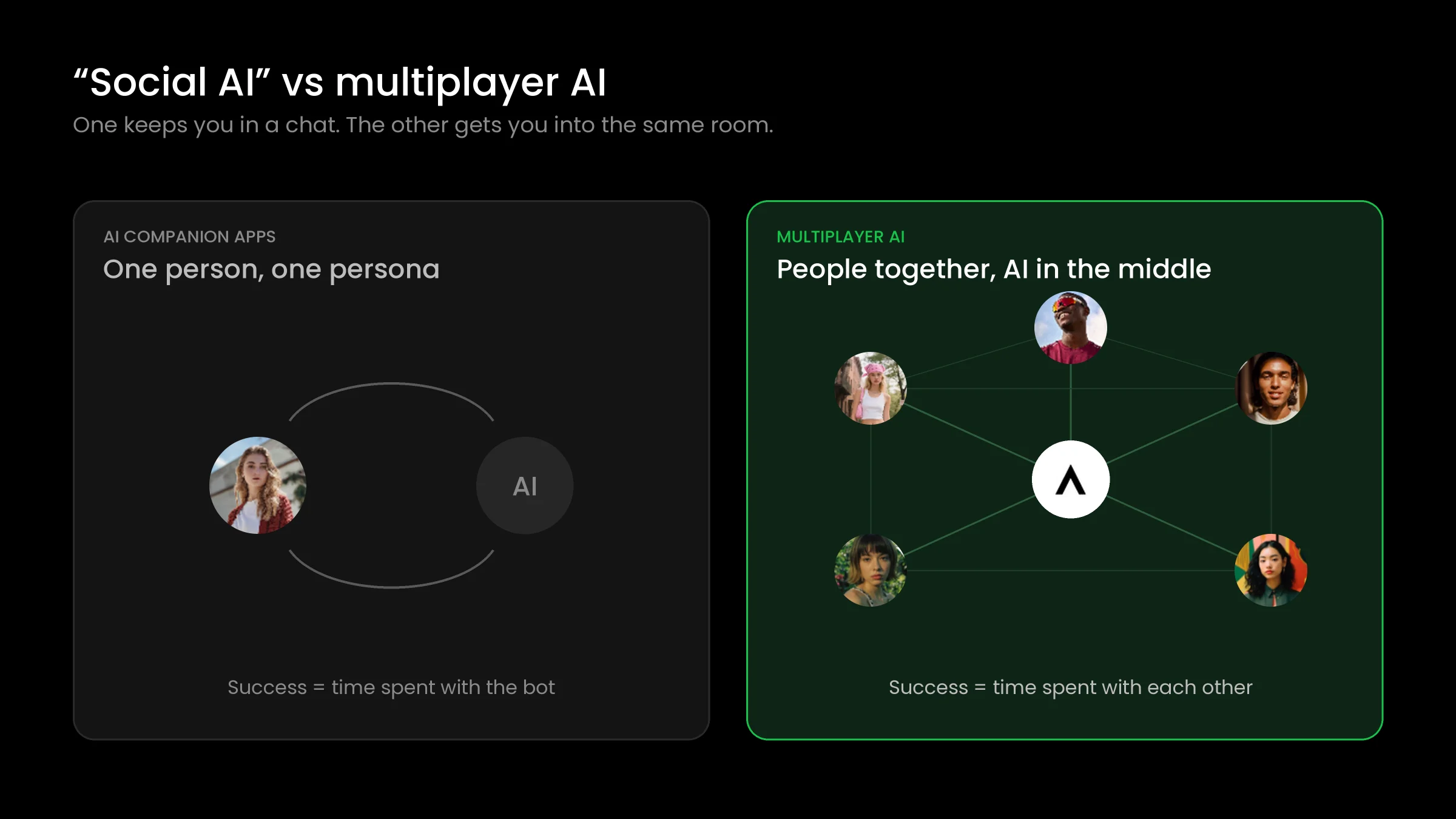
Much of what's marketed as "social AI" today is essentially single-player. Those products simulate a relationship and provide a sense of company. You open an app, pick an avatar, and engage in an ongoing one-on-one conversation with an AI companion or AI character. That creates a paradox. It is called social, but it never connects you to the world; it optimizes for screen time, emotional dependency, and engagement inside a digital silo.
Multiplayer AI is what social AI should mean. Instead of making AI the center of the social experience, it puts AI in service of human connection. AI can help people find common ground, coordinate plans, and turn online interactions into shared experiences in the real world. It is not to replace human relationships with AI. It is to use AI to make human relationships easier to start and maintain.
Where Anuma Fits: Multiplayer AI for Real Life
Most consumer AI experiences start with one person and one chatbot. Anuma is exploring what happens when AI helps people connect with each other. Anuma is multiplayer AI for real life. Anuma helps people discover others nearby who share their interests and move from online conversations toward meeting in person.
Anuma Nearby is currently live in New York City on iOS and Android.
FAQ
Is multiplayer AI the same as multi-agent AI?
No. Multiplayer AI focuses on the human experience, bringing multiple people and AI into the same collaborative space. Multi-agent AI focuses on task execution, orchestrating AI agents behind the scenes to solve complex problems. They address different layers of a product and can be used together.
Can an app be both multiplayer and multi-agent?
Yes. Anuma, for example, could let multiple people interact with AI in one shared conversation while specialized agents handle vibe checking, scheduling, and other tasks behind the scenes.
Do AI agents count as "players" in multiplayer AI?
In consumer applications, multiplayer AI generally refers to people interacting with AI together. AI agents may support that experience, but the focus remains on the people and what they can accomplish together.
Can multiplayer AI help people make friends?
Multiplayer AI can help discover people with shared interests, start conversations, and organize activities but whether those interactions become lasting friendships depends on the people involved.