The Best ChatGPT Group Chat Alternatives (2026)
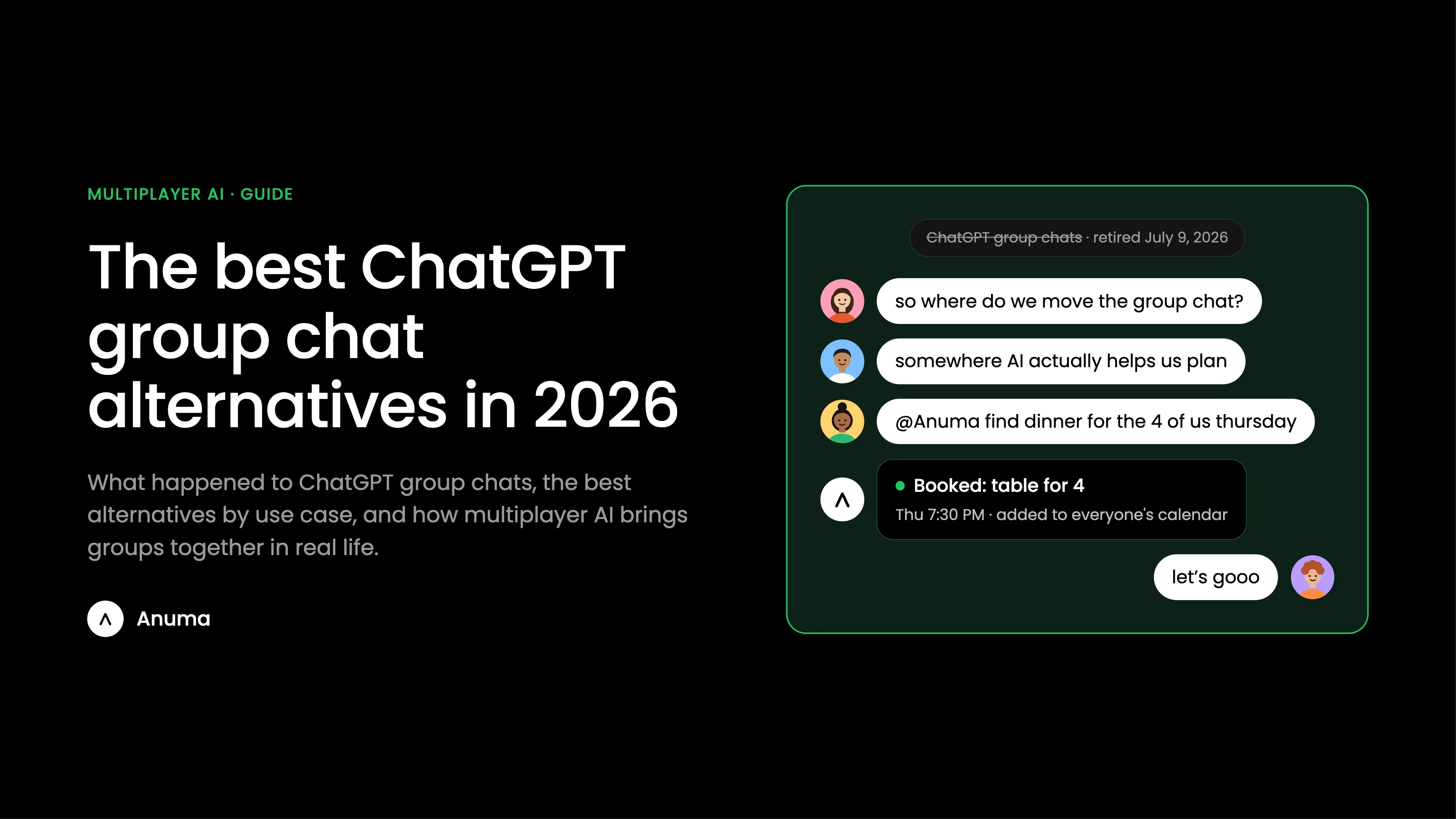
OpenAI began retiring ChatGPT group chats on July 9, 2026, less than eight months after the feature launched. People who used it to plan, brainstorm and make decisions with friends, family and coworkers are now looking for another way to bring AI into the same conversation.
Today’s ChatGPT group chat alternatives take a few familiar approaches: adding AI to messaging apps you already use, building social spaces around AI characters, or giving a group one AI agent for a task like a trip or a game. Nearly all of them stop at the groups you already have. A different model is taking shape: multiplayer AI that looks outward, helping you meet new people who share your interests, build new friend circles and turn group chats into real-world plans.
In this guide, we cover what happened to ChatGPT group chats, the best alternatives by use case, and how Anuma Nearby is building multiplayer AI for the friends you have as well as the ones you haven’t met yet.
What happened to ChatGPT group chats
OpenAI launched ChatGPT group chats as a pilot on November 13, 2025, in Japan, New Zealand, South Korea and Taiwan. The feature let people bring friends, family or coworkers into the same conversation with ChatGPT. Instead of asking an AI a question and forwarding the answer to everyone else, a group could interact with AI together. About a week later, OpenAI expanded group chats to logged-in users worldwide on Free, Go, Plus and Pro plans, with up to 20 people per conversation, even though the launch reaction was mixed.
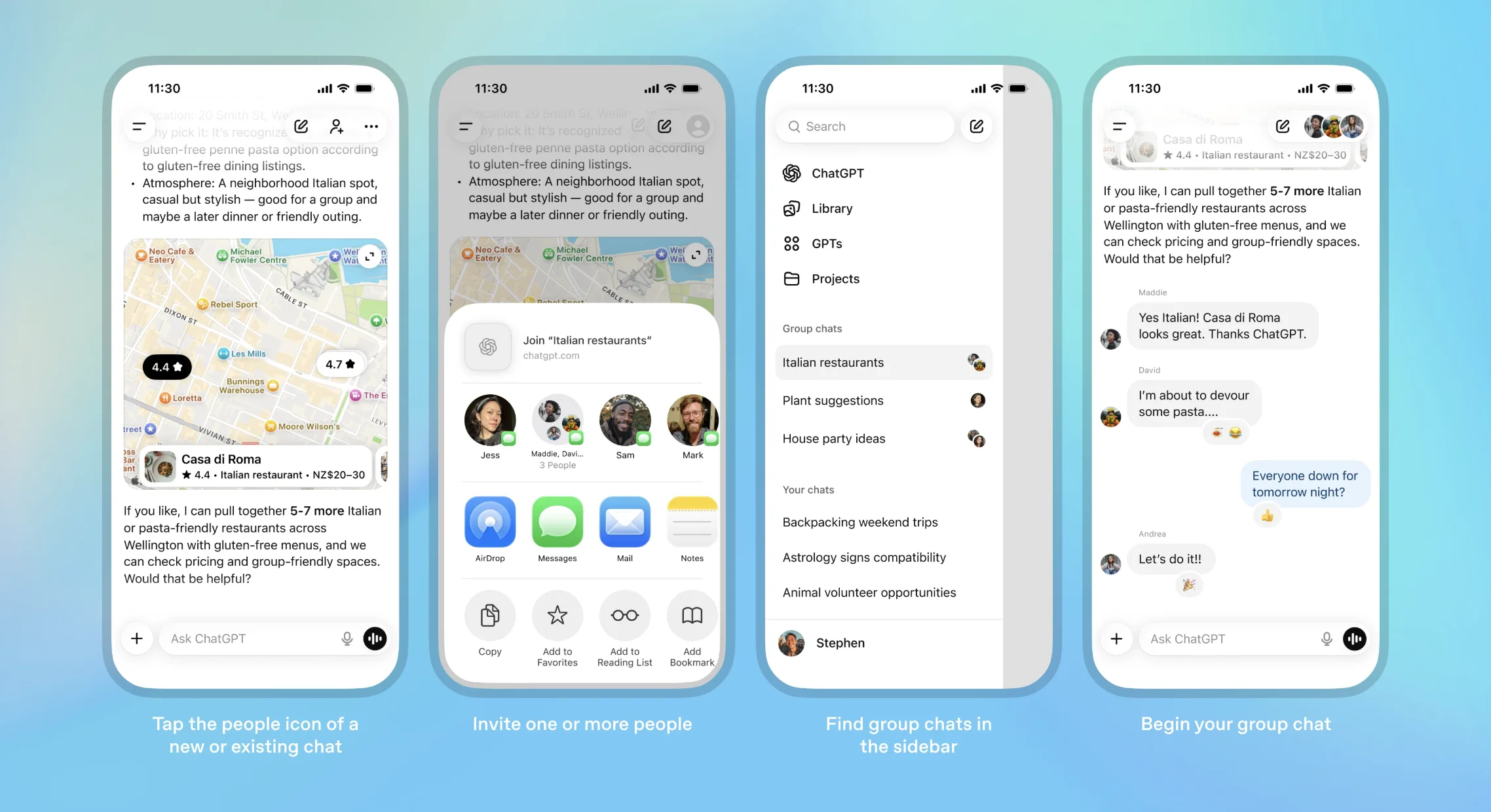
On July 9, 2026, OpenAI began winding the feature down. According to OpenAI’s support article on Retiring group chats in ChatGPT, the company is simplifying the ChatGPT experience and will apply what it learned from the pilot to future collaborative features. Since that date, users can no longer create a group chat, turn an existing conversation into one, or join through an invite link. Existing group chats remain viewable but are gradually becoming read-only; in the UK they already are. Microsoft followed a month later. It retired consumer Copilot group chats on August 18, 2026, without a replacement, and merged its consumer and business apps into a single Microsoft Copilot app focused on productivity: Word, Excel, Outlook, email and calendars. OpenAI didn’t build a replacement either. On the same day group chats were retired, it launched a new ChatGPT desktop app that brings Chat, Work and Codex together, and in September it added ChatGPT Space, a shared workspace for teams to edit documents with ChatGPT and Codex.
The exit drew some pushback on r/ChatGPT and OpenAI’s own community forum, where users asked for group chats back for studying, family decisions and planning with friends. But those requests drew few replies, and the exit barely made news.
Still, the pilot must have convinced OpenAI that people want AI in their conversations with others, since it brought group chats to every logged-in user within about a week. Why retire them eight months later then?
Why did OpenAI discontinue ChatGPT group chats?
OpenAI’s official answer is short: the company is simplifying ChatGPT while it applies what it learned to future collaborative experiences. It has not named specific problems. But the users asking for group chats back may point to some. They weren’t asking for the same feature. They wanted control over when the AI speaks, clearer privacy and a defined role for AI in the group. Behind those requests is a bigger question: what should AI actually do in a conversation with multiple people? The interface looked like a simple chat room with an AI participant. Underneath, multi-user AI raises several design challenges:
- A shared conversation is not the same as a shared context.
Most AI assistants are built around a two-party exchange: one person asks, and the AI answers. A group conversation is different. Each participant brings their own interests, opinions, preferences and constraints. When several people chat at once, the AI has to work out which message needs an answer. Giving everyone access to the same chatbot does not solve this on its own: the AI may chime in uninvited or lose the main thread of the conversation.
- Personalization becomes more complicated.
AI personalization is usually built around an individual. The model learns about one person's interests, preferences and history. In a shared conversation, whose preferences should the AI prioritize? OpenAI kept group chats separate: personal ChatGPT memory was not used in group chats, and group chats did not create new memories. That protected privacy, but it also meant the group could not draw on anyone’s AI context. The challenge is to build shared context without exposing what individuals did not intend to share. Users asking for group chats back want exactly that balance: private memories and custom instructions stay private unless someone chooses to share them.
- Knowing when to participate matters.
A good group conversation is not a queue of questions for an assistant. People talk to each other, disagree, joke, change topics and make decisions. An AI that responds to every message can become disruptive rather than helpful. ChatGPT tried to decide on its own when to reply and when to stay quiet. Users asked for more control, such as a simple setting to have the AI respond automatically, only when mentioned, or not at all unless asked.
Multiplayer AI needs to understand conversational boundaries: when to respond, when to wait, and when its contribution actually helps the group.
- Someone has to pay for the AI.
In ChatGPT group chats, messages between people were free, but each AI reply counted against the usage limits of the person ChatGPT was responding to. In an active group, that raises a fair question: who should cover the cost of a shared conversation?
- Group chats are social. ChatGPT isn’t.
Most people use ChatGPT on their own, as a personal advisor. In OpenAI’s own research, non-work messages made up 73% of consumer use, mostly practical guidance, information and writing. Social use is tiny: relationships and personal reflection made up about 1.9% of messages, and games and role-play just 0.4%. ChatGPT group chats asked people to bring friends into a tool they mostly use alone, with no friend list or social space to start from.
These are not necessarily limitations of the underlying AI model. They are product design challenges that appear when AI moves from individual assistance to shared social experiences. OpenAI and Microsoft retired their AI group chats within six weeks of each other, and both refocused on AI as a personal and work assistant. When OpenAI brought collaboration back, it came as a workspace for teams, not a group chat with friends. The lesson is clear: social AI needs a product built around people from the start.
AI group chat vs. multiplayer AI: What’s the difference?
Multiplayer AI is AI designed for groups of people, not one person and a chatbot. It shares context across everyone in the conversation and helps the group decide, plan and act together. It’s also different from multi-agent AI, which is about AI agents coordinating with each other. See how they compare.
Most conversational AI products today are single-player: one person prompts, one model responds. Add a group chat to that design and you still have an individual assistant trying to keep up with several people at once. Multiplayer AI starts with a different question: What can AI help people accomplish together? A group needs more than a smart answer in a shared thread. Every group has its own mix of interests, preferences, schedules, and dynamics. The AI needs to understand the group's shared context, knows when to contribute and helps move things forward. True multiplayer AI should be able to:
- Understand shared context. Know what the group is trying to accomplish, including each person’s interests, preferences and constraints.
- Respect what’s personal. Use what each person chooses to share, and keep the rest private.
- Reconcile multiple perspectives. Help the group find common ground rather than simply answering whoever spoke last.
- Participate only when needed. Speak up when it adds value, such as answering a question or helping the group decide, and stay quiet otherwise.
- Act beyond conversation. Turn discussions into outcomes, such as coordinating schedules, comparing options and organizing activities.
- Continue in the real world. Keep going after someone closes the chat, helping people carry shared plans into real experiences and relationships.
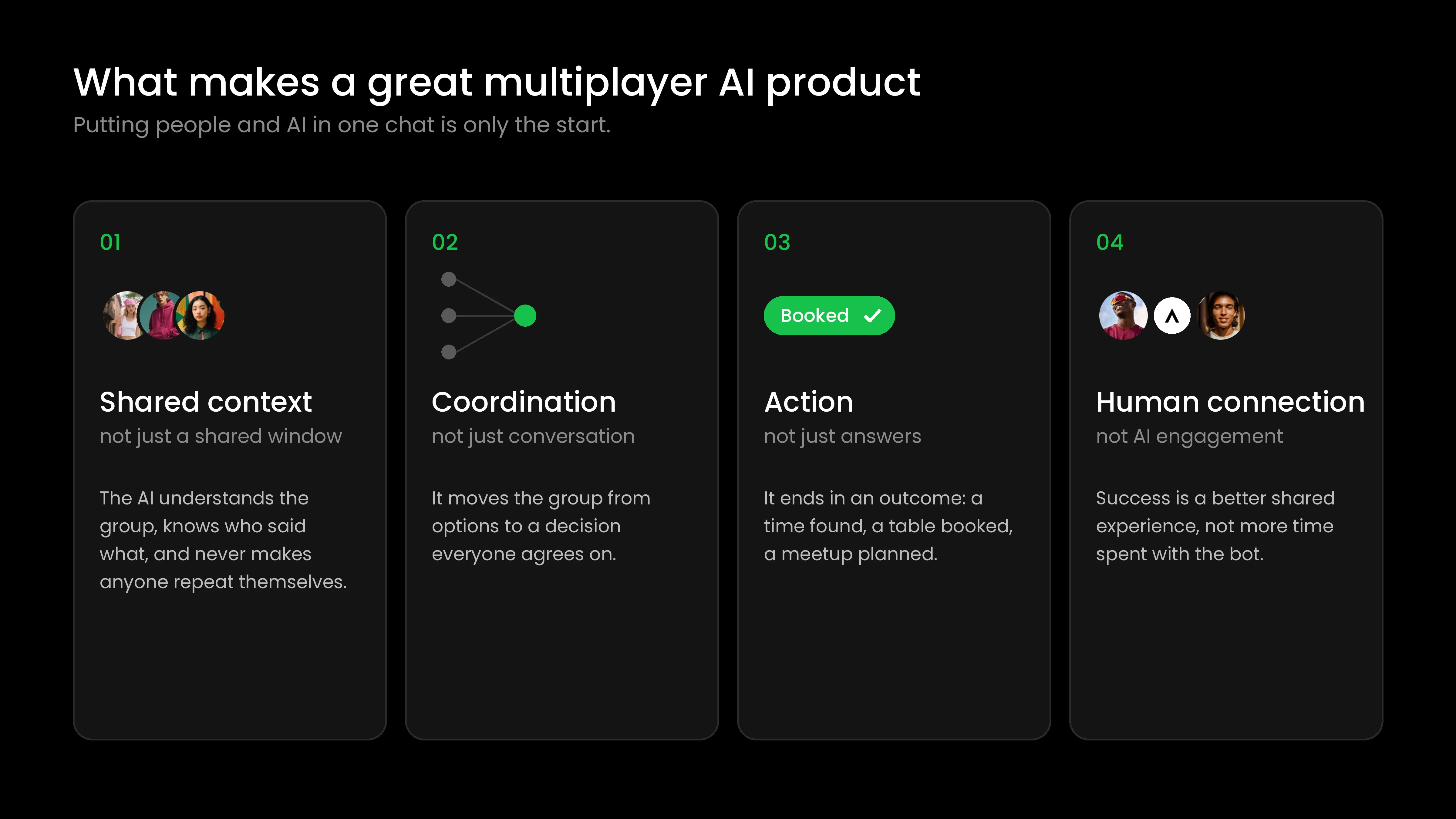
This is the approach Anuma is taking, starting with the moment a group chat turns into a plan to meet up.
How Anuma is pioneering multiplayer AI for real life
Anuma takes multiplayer AI beyond a shared chatbot conversation. Instead of treating AI as another participant whose primary job is generating responses, Anuma uses AI to help people discover common interests, find one another and make plans in the real world.
- From personal AI to shared experiences.
Anuma brings together AI conversations, personal context and physical proximity. It learns your interests from your conversations and the memories you choose to share, then uses that context to help you discover people nearby you may connect with. Instead of relying on profile descriptions or random introductions, Anuma can show what you have in common with someone before you start talking.
- From group chat to IRL plans.
Tag @Anuma in a group chat and ask for help with the next step. It can find a restaurant everyone agrees on, sync calendars to find a time that works, and book the table. It can also surface events and activities happening nearby, or people who share the group’s interests. The goal is to help the group reach a real outcome, not just a longer conversation.
- From online interaction to real-world connection
This is where Anuma differs from conventional AI group chat products. Most social platforms are designed to keep you inside the app. Anuma uses AI to help people discover connections and activities outside the screen. Anuma provides a live map of people and meetups, showing shared interests and why two people might get along. Anuma's vision for multiplayer AI is not simply more people talking to AI. It is AI helping more people connect with one another. See how it works on Anuma Nearby.
Scenario: Four friends want to meet for dinner.
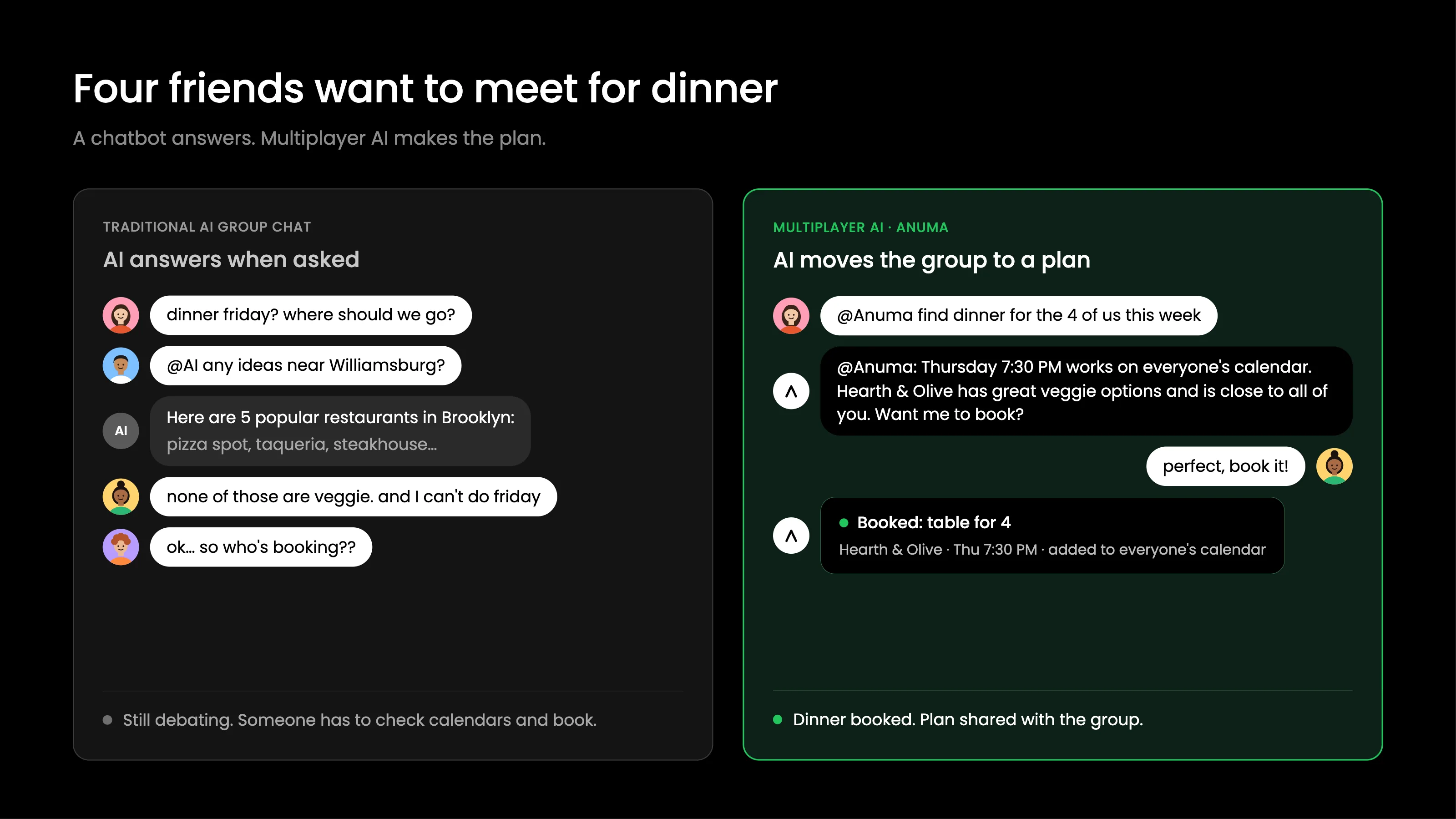
In a traditional AI group chat, the friends debate where to eat until someone asks the AI, which lists a few restaurants. The group then debates the list, and someone still has to check everyone’s availability and book the table. With Anuma, someone tags @Anuma, and it suggests places that fit the group’s tastes and location. It syncs calendars to find a time that works for everyone, books the table and shares the plan with the group. The conversation ends with a dinner, not a debate.
Anuma is built for groups that want to get off their phones and meet up. Depending on what your group needs, other ChatGPT group chat alternatives may be a better fit.
The best ChatGPT group chat alternatives in 2026
Before choosing an alternative, it helps to know what your group actually wants AI to do.
How people use AI in group chats
Group chats are where life happens. In a GIPHY survey, 79% of people said they share major life updates with their group chats before their families, and about 89% of Gen Z and millennials consult their group chat before major decisions. Yet AI has mostly arrived in work chats first: half of Slack messages now come from apps and agents, while relationships and games make up only a tiny share of ChatGPT conversations. AI is already a regular part of work chats; in group chats with friends and family where people share the most, it’s only getting started.
Groups bring AI into their conversations for two broad reasons: to enjoy time together and to get things done.
With friends and family
- Planning dinners, weekend plans and trips.
- Settling debates and answering questions on the spot.
- Studying together and quizzing each other.
- Playing games and running roleplay stories.
- Meeting new people who share your interests.
At work
- Summarizing busy channels and long threads.
- Drafting documents and plans as a team.
- Tracking tasks, owners and decisions.
- Handing off work so a teammate can pick it up.
The best ChatGPT group chat alternative depends on what your group wants AI to do. Some alternatives bring AI into messaging apps you already use. Others build social experiences around AI characters or models, and some focus on specific goals like travel or meeting people in person. Here are eight alternatives worth considering. Anuma is our product so we list it first, and we’ve aimed to describe every alternative fairly, by what it does best.
Best ChatGPT group chat alternatives for friends and family
1. Anuma: Best for real-world connections and group plans
Anuma is the best ChatGPT group chat alternative for friends who want AI to help them plan and meet up in real life. In an Anuma group chat, anyone can tag @Anuma to find a restaurant, sync calendars, book a table, or discover events and people nearby who share the group’s interests.
Best for:
- Meeting new people nearby.
- Planning meetups with friends.
- Turning group chats into real plans.
Why choose it: Anuma is multiplayer AI built for real life. It connects group chats with the people, places and activities around you, instead of keeping the conversation on a screen.
Website: https://www.anuma.ai/
2. Meta AI: Best for AI inside the messaging apps you already use
Meta AI is a ChatGPT group chat alternative for groups that want AI inside WhatsApp, Messenger or Instagram without downloading a new app. In a group chat, anyone can mention Meta AI to ask a question, get recommendations or generate images, and everyone in the chat sees the reply.
Best for:
- Quick questions in group chats you already have.
- Generating images together with friends.
- Groups that don’t want to switch apps.
Why choose it: Convenience. Meta AI works inside apps your group already uses every day.
Website: https://www.meta.ai
3. Snapchat My AI: Best for Snapchat friend groups
Snapchat My AI is a ChatGPT group chat alternative for friends who already chat on Snapchat. Typing @myai in a group chat brings Snapchat’s chatbot into the conversation to answer questions for the group, and a sparkle next to its name shows it’s AI.
Best for:
- Friend groups that already use Snapchat every day.
- Quick recommendations for places and things to do nearby.
- Casual questions and fun moments in group chats.
Why choose it: If your friends already live on Snapchat, AI is one @ mention away.
Website: https://www.snapchat.com/
4. Poe: Best for groups that want many AI models in one chat
Poe is a ChatGPT group chat alternative for groups that want to use many different AI models together. Poe, from Quora, lets up to 200 people chat in one conversation with more than 200 AI models, including text, image, video and audio models, plus bots made by the community.
Best for:
- Comparing answers from different AI models as a group.
- Large communities, clubs and classes.
- Creative projects that mix text, images, video and audio.
Why choose it: Poe offers the widest choice of AI models and the largest group size on this list.
Website: https://poe.com/
5. Shapes: Best for AI characters and entertainment
Shapes is a ChatGPT group chat alternative for friends who want to hang out with AI characters together. On Shapes, friends and customizable AI characters, called Shapes, chat in the same group, and users can create their own characters or add ones from a large community catalog.
Best for:
- Chatting with AI characters alongside friends.
- Roleplay and collaborative storytelling.
- Fandom communities and entertainment.
Why choose it: Shapes focuses on making AI interaction entertaining and social, particularly around customizable characters and shared creative experiences.
Website: https://shapes.inc/
6. Mindtrip: Best for planning group trips
Mindtrip is a ChatGPT group chat alternative for friends and families planning a trip together. Each Mindtrip trip has its own group chat, where travelers share ideas and comments and tag @Mindtrip for suggestions that balance everyone’s preferences.
Best for:
- Group vacations and family trips.
- Building one shared itinerary together.
- Keeping trip ideas, chats and plans in one place.
Why choose it: Mindtrip is purpose-built for travel, from first idea to shared itinerary.
Website: https://mindtrip.ai/
7. Jenova: Best for co-op roleplay run by an AI game master
Jenova is a ChatGPT group chat alternative for friends who want an AI game master to run a shared roleplay campaign. Players join one live thread, each controls their own character, and Jenova’s Roleplay Game Master responds to everyone’s moves and keeps the story consistent over long sessions.
Best for:
- Co-op roleplay with friends.
- Turn-based story campaigns.
- Ready-made adventures.
Why choose it: Jenova acts as the game master for the whole table. Players act in the story, and the chat owner can step in as co-game master to set rules and lore.
Website: https://www.jenova.ai/
8. Instinct: Best for getting tasks done with a personal AI agent
Instinct is a ChatGPT group chat alternative for friends who want an AI agent to handle tasks for the whole group. When someone adds Instinct to an iMessage group chat, a new Instinct agent joins and works for everyone, helping with things like travel plans, event tickets, carpools or who’s bringing what to dinner. Friends don’t need an Instinct account to take part.
Best for:
- Coordinating plans and logistics with friends.
- Group tasks like booking tickets or organizing carpools.
- People who already use Instinct as a personal agent.
Why choose it: Instinct brings a capable personal agent into the group, while keeping each person’s own account and information separate unless they give permission.
Website: https://instinct.com/
Best ChatGPT group chat alternatives for work
If your group chat is for work, AI built into your team’s workspace is usually a better fit than a social app. AI is already part of team chat: Salesforce reports that half of Slack messages now come from apps and agents, and 1.9 million people use third-party agents in Slack every week.
- Slack with AI agents: Slack’s built-in AI and third-party agents can summarize channels, search past decisions and take on tasks where your team already works.
- Claude Tag: Tag @Claude in a Slack channel and a shared AI teammate works on tasks the whole team can see and pick up. Launched by Anthropic in June 2026 for Claude Team and Enterprise plans.
- ChatGPT Spaces: OpenAI’s collaborative workspace, where teammates and AI agents work on shared projects together.
Choose the best ChatGPT group chat alternative by use case
Before moving your group to another platform, decide what you actually want AI to do. There is no single replacement for every use case. If you want quick answers inside a messaging app you already use, Meta AI or Snapchat My AI may be enough. If you want an AI agent to handle group tasks in iMessage, try Instinct. If you want to hang out with AI characters, try Shapes, and for a roleplay campaign, try Jenova. For group trips, Mindtrip is built for the job. If your group chat is for work, try AI in the tools your team already uses, like Slack, Claude Tag or ChatGPT Spaces. But if your goal is to meet new people nearby and turn group chats into real-world plans, Anuma is the best choice.
| Use Case | Best Tool | Strengths & Capabilities |
|---|---|---|
| Meet new people and make real-world plans | Anuma | Multiplayer AI built for real life. Discover people nearby who share your interests, and @Anuma in a group chat to sync calendars, book tables and plan meetups IRL. |
| Ask AI inside WhatsApp, Messenger and Instagram | Meta AI | Type @Meta AI in a group chat to ask a question (available in select countries). |
| Bring AI into Snapchat friend groups | Snapchat My AI | Type @myai in a group chat for answers and nearby recommendations from the Snap Map. |
| Use many AI models together | Poe | Up to 200 people and 200+ text, image, video and audio models in one conversation. |
| Hang out with AI characters | Shapes | Friends and customizable AI characters chat together in an entertainment-first social space. |
| Plan a group trip | Mindtrip | Each trip has its own group chat. Tag @Mindtrip for suggestions that balance everyone’s preferences. |
| Run a co-op roleplay campaign | Jenova | An AI game master runs the story for several players, with round-based play and owner control over rules and lore. |
| Get group tasks done with an AI agent | Instinct | An AI agent joins your iMessage group to handle tasks like tickets and carpools, even for friends without an account. |
| Work with AI as a team | Slack, Claude Tag or ChatGPT Spaces | Shared AI in the tools your team already uses, for summaries, drafts and tasks. |
Conclusion: Choosing the right ChatGPT group chat alternative
ChatGPT group chats showed that people want AI in their conversations with others. Their retirement left those groups looking for alternatives, and there are now options for almost every use case. Meta AI and Snapchat My AI bring quick answers into the apps you already use. Instinct handles group tasks in iMessage. Poe puts many AI models in one chat. Shapes and Jenova make AI social and playful. Mindtrip plans the trip. At work, Slack’s AI agents, Claude Tag and ChatGPT Space bring AI into team channels.
But almost all of these tools work with the group you already have. Anuma brings multiplayer AI to real life: it helps you make plans with your friends and meet new ones nearby. Anuma Nearby is live in New York City on iOS and Android. Get started at anuma.ai/nearby.
FAQ
What happened to ChatGPT group chats? OpenAI began retiring ChatGPT group chats on July 9, 2026. According to OpenAI, you can no longer create a group chat, turn a conversation into one, or join through an invite link.
Are ChatGPT group chats coming back? OpenAI has not announced a plan or timeline to restore the original group chat feature. It has said it will use lessons from the pilot to inform future collaborative experiences.
Can I still see my old ChatGPT group chats? Yes. You can review past messages, files and images after a chat becomes read-only, and you can request an export through ChatGPT or the OpenAI Privacy Portal.
What is the best ChatGPT group chat alternative? For friends who want AI to help them plan and meet up in real life, Anuma is the best ChatGPT group chat alternative, and Anuma Nearby also helps you meet new people nearby. Try Shapes for AI characters, Instinct for group tasks in iMessage, and Meta AI for quick questions inside WhatsApp or Messenger. For work, try Slack, Claude Tag or ChatGPT Spaces.
What is multiplayer AI? Multiplayer AI is AI designed for groups of people, not one person and a chatbot. It shares context across everyone in the conversation and helps the group decide, plan and act together. Anuma applies multiplayer AI to real life, helping friends make plans and meet new people nearby.
What is the difference between an AI group chat and "Multiplayer AI"? An AI group chat typically refers to a conventional 1-on-1 bot dropped into a shared messaging channel. Multiplayer AI is designed specifically around group dynamics: it keeps shared context, knows when to speak, helps the group reach a decision and coordinates multi-step plans across everyone in the chat. Learn more about multiplayer AI.