The Week Frontier AI Got Cheaper, Pricier, and Unlocked All at Once
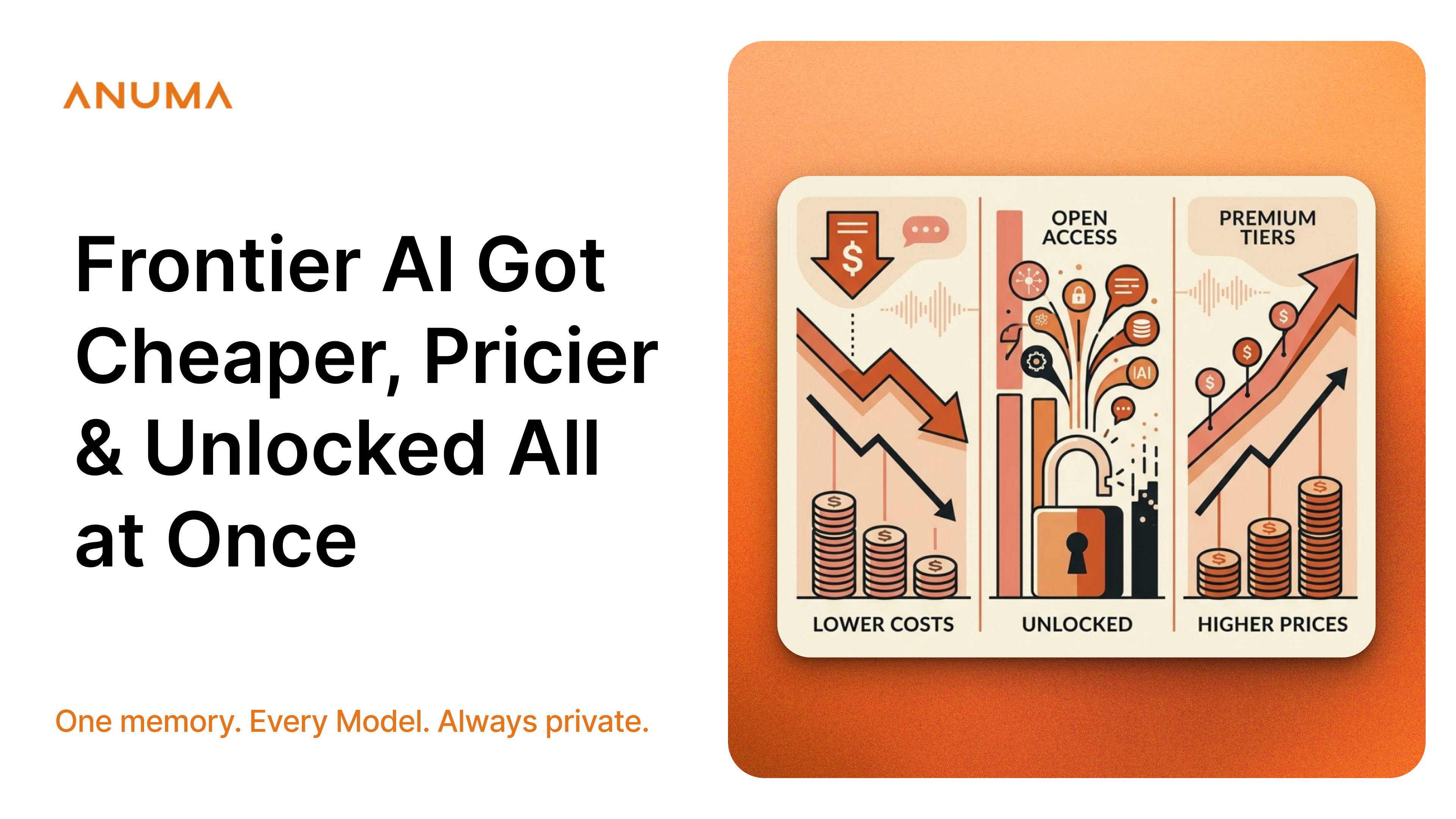
The frontier models moved in every direction this week. Meta put its first model behind a paid developer API, priced well below most competitors. Agent capable AI became dramatically cheaper. The most advanced public model got a price tag. OpenAI made its strongest models broadly available after an initial limited rollout. And conversations with AI became more natural than ever.
If the past month showed that access to frontier AI increasingly depends on rollout decisions and policy, this week highlighted the other side of the equation: pricing. Who gets access still matters, but so does what that access costs, and both are changing quickly.
Here are the six stories that shaped consumer AI this week.
No. 1
Meta starts charging for AI, and undercuts everyone
On July 9, Meta released Muse Spark 1.1 and, for the first time, put its own model behind a paid developer API. The Meta Model API launched in public preview for US developers at $1.25 per million input tokens and $4.25 per million output tokens, with $20 in free credits and an OpenAI-compatible interface that makes switching a base-URL change rather than a rewrite. Early partners include Replit, Cline, and Box.
The pricing is what stands out most: roughly a quarter of what OpenAI and Anthropic charge for their flagships. Meta says Muse Spark 1.1 is competitive with GPT-5.5 and Opus 4.8 on a range of agentic benchmarks. Early independent evaluations place it among today's leading general purpose models, particularly for tool use, while showing somewhat weaker coding performance than the strongest specialist models.
The consumer side is just as significant. Muse Spark 1.1 is live now in Thinking mode in the Meta AI app and on meta.ai, and Meta says it will replace Llama as the assistant layer across WhatsApp, Instagram, Facebook, and its smart glasses. It is also a philosophical reversal: the company that built its AI reputation on open-source Llama just shipped a closed-weight, paid model. The open-source champion has joined the business model it spent years positioning against.
No. 2
Claude Sonnet 5 makes agent-grade AI cheap
On June 30, Anthropic launched Claude Sonnet 5, and it is now the default model for Free and Pro plans. The pitch: performance close to Opus 4.8, its far more expensive sibling, at a fraction of the cost. It plans, uses tools like browsers and terminals, and runs autonomously at a level that a few months ago required larger and pricier models.
Pricing lands at $2 per million input tokens and $10 per million output through August 31, then $3 and $15. That undercuts Opus 4.8, GPT-5.5, and Gemini 3.1 Pro. Sonnet 5 also ships with a 1 million token context window by default and lower rates of hallucination and sycophancy than its predecessor.
The takeaway is the direction of travel. Capabilities that recently required premium frontier models are quickly moving into lower priced and even free tiers. If you have not revisited what mid-tier models can do lately, your assumptions are probably out of date.
No. 3
Fable 5 came back with a price tag
Fable 5 returned on July 1 after its 19-day government-ordered suspension, but it came back with a timer attached. Anthropic's terms: Pro, Max, Team, and select Enterprise subscribers get Fable 5 within up to half of their plan's weekly usage limit at no extra cost, but only through a short included window. After that, Fable 5 access requires usage credits at $10 per million input tokens and $50 per million output tokens, on top of any subscription.
The cutoff was originally set for July 7. Hours before the deadline, after subscriber backlash, Anthropic extended the included window through July 12, with credit billing starting July 13. The company says the move is a temporary capacity measure and that it aims to restore Fable 5 to standard plans when capacity allows, but it has given no date.
At published API credit rates, Fable 5 is among the most expensive publicly available frontier models, costing roughly twice as much as Opus 4.8 and around five times Sonnet 5's introductory pricing. The lesson pairs with story No. 2. The frontier is splitting into tiers: yesterday's flagship capability is becoming cheap and included, while today's frontier costs extra. Which model you reach for is becoming a per-task decision, not a subscription decision.
No. 4
GPT-5.6 goes public after 12 days behind a government gate
Today, July 9, OpenAI made the GPT-5.6 family generally available across ChatGPT, Codex, and the API, with the global rollout completing over 24 hours. Sol is the flagship, Terra matches GPT-5.5 at roughly half the cost, and Luna is the fast, cheap tier. Paid ChatGPT users get Sol; free users get Terra.
The models are strong. OpenAI reports state-of-the-art results on agentic coding and knowledge work benchmarks, in several cases ahead of Fable 5 at a fraction of the cost. Alongside the models, OpenAI shipped ChatGPT Work, a desktop agent for Mac and Windows that can act across local files, installed apps, and a built-in browser.
But the bigger story is how it got here. GPT-5.6 spent twelve days limited to roughly 20 government-vetted organizations while the Commerce Department's AI standards center ran additional tests, then cleared the broad rollout. The review was described as voluntary, but in practice it functioned much like a pre-clearance process. First Fable 5, now GPT-5.6: two frontier launches in a row have run through government review before reaching the public.
No. 5
ChatGPT can finally hold a real conversation
On July 8, OpenAI launched GPT-Live, a new generation of voice models that replaces Advanced Voice Mode in ChatGPT. The architecture is the story: GPT-Live is full-duplex, meaning it listens and speaks at the same time. You can interrupt it mid-sentence, pause to think without it jumping in, and hear it acknowledge you with a "mhmm" while you talk.
It is also more capable than previous ChatGPT voice modes. For questions needing web search or deeper reasoning, GPT-Live quietly delegates to GPT-5.5 in the background and keeps the conversation going while it works. It handles live translation and shows visual cards for things like weather and stocks. GPT-Live-1 is now the default for paid ChatGPT users, with GPT-Live-1 mini for free users, rolling out globally on iOS, Android, and web.
More than 150 million people already talk to ChatGPT every week. With Apple's rebuilt Siri arriving this year and Amazon upgrading Alexa, the voice race we flagged a month ago is now fully on. Voice is quietly becoming a primary way people use AI, not a novelty feature.
No. 6
Google's free personalization, paid in data
On June 29, Google made Gemini's personalized image generation free for all eligible US users, dropping a paywall that had limited it to paid AI subscribers since April. The feature creates images tuned to your life without detailed prompts, by drawing on your connected Google services: Gmail, Google Photos, YouTube, and Search. It can even use photos from your Google Photos library, with your permission, without requiring manual uploads. Access is controlled through an opt-in Personal Intelligence feature, and a sources button shows which personal data shaped each image.
It is a genuinely useful capability, and the opt-in control matters. But be clear about the trade. The personalization runs on your inbox, your photo library, and your search history, held and processed within Google's ecosystem, a business that is largely funded through advertising. "Free" personalization is paid for in data.
Personal AI works best when it knows you. The question every consumer should ask is who else gets to know you in the process.
From Anuma
Know what you pay, and what you pay with
This week the AI market showed both of its price tags. Money: frontier models now range from included-free to metered-extra, and the right model changes task by task. And data: the deepest personalization on offer runs on your email and photos.
Anuma is built to get you the best of both sides. One subscription gives you access to leading AI models, so you can choose the right one for each task without juggling multiple providers or usage meters. Your personal memory works across models, encrypted, portable, and under your control.
Personal AI should know you. Nobody else needs to.
Sources
- Meta: Introducing Muse Spark 1.1
- Anthropic: Introducing Claude Sonnet 5
- Android Authority: Claude Fable 5 promotion extended after backlash over early cutoff
- OpenAI: GPT-5.6: Frontier intelligence that scales with your ambition
- TechTimes: GPT-5.6 goes public after 12-day White House gate
- OpenAI: Introducing GPT-Live
- Google: The Gemini app is bringing personalized image creation to more users